

Board Performance · 2025
In this section14 topics
- Compliance Monitoring — Overview2 items
- Prevention of Conflicts of Interest4 items
- Prevention of the Use of Inside Information3 items
- Anti-Corruption5 items
- Whistleblowing4 items
- Selection of Directors & Chief Executives6 items
- Selection of Independent Directors2 items
- Director Development4 items
- Evaluation of Board & Subcommittee Performance3 items
- Subcommittees1 item
- Meeting Attendance & Remuneration5 items
- Supervision of Subsidiaries & Associated Companies4 items
- Board Duty Performance — Overview1 item
- Audit Committee Duty Performance1 item
Compliance Monitoring — Overview
Compliance Monitoring — Introduction
The Bank places continuous importance on shareholders’ rights and its responsibilities toward shareholders and stakeholders, ensuring equitable treatment of shareholders, recognizing the role of stakeholders, promoting information disclosure and transparency, and emphasizing the Board of Directors’ accountability and adherence to good corporate governance principles in order to enhance confidence among shareholders, investors, and all stakeholders; accordingly, the Board has approved the establishment of a comprehensive Good Corporate Governance Policy covering the structure, roles, duties, and responsibilities of the Board of Directors and its sub-committees, as well as clear, transparent, and accountable management principles to ensure that all Bank operations are conducted fairly and with due regard to the best interests of shareholders and stakeholders.
The Bank’s business operations under this Good Corporate Governance Policy set out practical guidelines to ensure that directors, executives, and employees understand and adopt them as a framework for performing their duties, encompassing nine key principles:
defining objectives and core business goals for sustainability
establishing or approving an effective risk governance framework
implementing an effective remuneration structure
adopting a whistleblowing policy and procedure
maintaining internal control and internal audit policies
disclosing governance information to stakeholders;
ensuring financial reliability and transparent disclosure
supporting shareholder engagement and communication
promoting innovation and responsible business conduct.
The Bank will continue to monitor compliance with the aforementioned good corporate governance policies and guidelines.
Monitoring of Compliance with Other CG Policies & Guidelines
In the past year, the Bank has conducted its business in strict compliance with its corporate governance policies and practices to enhance transparency, accountability, and stakeholder confidence, placing strong emphasis on adherence to the Corporate Governance Code (CG Code) alongside sustainable business operations, while continuously evaluating, reviewing, and improving its processes to ensure transparent, fair, and auditable management—particularly in risk management, internal control, and compliance with applicable laws, regulations, and international standards—thereby reflecting its firm commitment to maintaining high operational standards and complying rigorously with the requirements of relevant regulatory authorities, including the Stock Exchange of Thailand, the Securities and Exchange Commission, and other supervisory bodies, in support of sustainable growth and long-term value creation for stakeholders, with key highlights in 2025 as follows:
In 2025, the Bank had no news/cases where directors were fined, accused, or subjected to civil action by regulatory authorities (e.g., SEC, SET, or NACC) in relation to fraudulent acts.
In 2025, the Bank had no cases of independent directors/non-executive directors resigning due to issues concerning the Bank's corporate governance, nor were there any cases of the entire Audit Committee/Independent Directors resigning.
In 2025, the Bank had no cases of directors committing serious ethical violations contrary to regulations, as determined by regulatory authorities.
In 2025, no directors or executives were found to have traded securities during the period designated by the company as a blackout period.
Prevention of Conflicts of Interest
Introduction
The Bank places importance on monitoring compliance with its policies and practices relating to good corporate governance, including its Code of Business Conduct, and promotes their effective and genuine implementation in order to build confidence among directors, executives, employees, and all groups of stakeholders.
Has the Company Acted to Prevent Conflicts of Interest?
No
Operations in the Past Year
The Bank places significant importance on considering transactions with transparency and in the best interests of the Bank, and therefore emphasizes the prevention of transactions that may give rise to conflicts of interest, intercompany transactions, or connected transactions; accordingly, the Bank has established a Conflict of Interest Policy to control and prevent conflicts of interest and to ensure that directors, executives, and employees understand and comply with applicable laws and relevant regulations, which policy has been communicated to all directors, executives, and employees, requiring them to avoid any actions that may give rise to direct or indirect conflicts of interest and to disclose their own interests and those of related persons to the Board of Directors, particularly in relation to relationships or transactions with the Bank and its subsidiaries that may create conflicts of interest prior to entering into such transactions, while the Bank also conducts an annual year-end survey of persons with interests and related transactions covering directors, executives, related persons, and relevant employees, and presents such information to the Audit Committee and the Board of Directors for acknowledgement at least once a year.
The Bank has communicated the Conflict of Interest Policy to directors, executives, and employees through the intranet system and has provided various learning materials to enhance knowledge and understanding.
In the past year, the Bank did not identify any violations or non-compliance with regulations relating to the prevention of conflicts of interest.
Number of Conflict-of-Interest Cases
| Metric | Current Year | Previous Year | Two Years Ago |
|---|---|---|---|
| Total number of cases or issues related to conflicts of interest (cases) | 0 | 0 | 0 |
Prevention of the Use of Inside Information
Has the Company Acted to Prevent the Use of Inside Information?
Yes
Operations in the Past Year
The Bank has established an Insider Information Prevention Policy to promote understanding, communication, and clear guidance on the prevention of insider trading for its personnel. The Bank ensures that employees at all levels strictly comply with the Bank’s charter and code of conduct, as well as the guidelines on the use of inside information under the Securities and Exchange Act and other relevant regulations, in order to prevent the disclosure of confidential information and the misuse of insider information. The policy has been communicated to all directors, executives, and employees, with the following key principles:
All departments must implement appropriate systems to safeguard insider information from being disclosed to unauthorized persons. The use or dissemination of insider information must be limited strictly to those who need to know for the performance of their duties.
Directors and executives, including those holding positions at vice president level or above (or equivalent) in the finance and accounting functions, employees in units with access to insider information, as well as their spouses or cohabiting partners and minor children who are in possession of material non-public information affecting the price or value of the Bank’s securities, must refrain from trading the Bank’s securities during the 30-day period prior to the disclosure of quarterly and annual financial statements or other information relating to the Bank’s financial position and status, and within 24 hours after such information has been publicly disclosed.
Directors, executives, including those holding management level positions in the finance and accounting functions equivalent to department manager or higher, the Bank’s auditor, as well as plan preparers, plan administrators, and temporary plan administrators under bankruptcy law, are required to prepare, disclose, and submit reports on their holdings and changes in holdings of securities and derivatives, including those of their spouses or cohabiting partners and minor children, as well as juristic persons in which such persons collectively hold more than 30 percent of the total voting rights and represent the largest shareholding in that juristic person.
The Bank has communicated the Insider Information Prevention Policy to directors, executives, and employees through the intranet system and has provided various learning materials to enhance knowledge and understanding. In 2025, the Corporate Secretary informed directors and executives of the 30-day blackout period prior to the disclosure of quarterly and annual financial statements or other financial information, and within 24 hours after such disclosure. Directors were notified through meeting agendas, while executives and employees were informed via email. The Bank also reports securities trading activities to the Board on a quarterly basis. Furthermore, the Bank did not find any violations, nor did it receive any whistleblowing reports or complaints regarding insider trading in breach of the policy or good corporate governance principles.
Number of Inside-Information Cases
| Metric | Current Year | Previous Year | Two Years Ago |
|---|---|---|---|
| Total number of cases or issues related to the use of inside information to seek benefits (cases) | 0 | 0 | 0 |
Anti-Corruption
Introduction
The Bank is committed to ensuring that it has effective processes in place to promote anti-corruption practices across all types of its transactions. This Anti-Corruption Policy has been approved by the Board of Directors, which establishes and supports a culture in which personnel at all levels perform their duties with integrity and transparency and must not violate the following principles:
The Bank adheres to the principle of opposing all forms of corruption, whether direct or indirect.
The Bank conducts its business in accordance with anti-corruption principles, adhering strictly to ethical and moral standards. This includes establishing formal written documentation, implementing policies and operational guidelines, and ensuring appropriate risk management, internal and external communication, monitoring, and review processes across all departments of the Bank.
Has the Company Acted on Anti-Corruption?
Yes
Operations in the Past Year
The Bank is committed to opposing all forms of corruption and to encouraging the Bank’s directors, executives, and employees to develop an awareness of preventing bribery, to remain vigilant, and to report any indications or suspicions of bribery in any form. The Bank has established clear anti-corruption policies and guidelines. In addition, the Bank has provided channels for reporting any illegal acts, violations of the Code of Conduct, or behaviors that may indicate corruption or misconduct. Any breach or non-compliance with this Anti-Corruption Policy shall be deemed a disciplinary violation of the Bank and shall result in disciplinary actions in accordance with the relevant rules, policies, regulations, orders, announcements, and applicable laws, which may also lead to civil or criminal liability. The Bank may impose disciplinary penalties in addition to civil or criminal penalties imposed by regulatory or enforcement authorities. The severity of disciplinary actions will depend on the seriousness of the violation. Disciplinary actions may include warnings, mandatory additional training on anti-corruption compliance, or termination of employment.
As of 31 March 2025, the Bank obtained its third renewal of membership in the Thai Private Sector Collective Action Coalition Against Corruption (CAC), valid for another three years until 31 March 2028.
Summary of the Bank’s Anti-Corruption Initiatives
The Bank disseminates its Anti-Corruption Policy and related guidelines both internally and externally to ensure that all relevant stakeholders are aware of the Bank’s intentions and commitment to combating all forms of corruption. This is carried out through various activities and communication channels, such as publishing documents on the Bank’s Intranet and website, distributing policy communications to employees via email, and requiring employees to acknowledge compliance with the Anti-Corruption Policy.
The Bank conducts assessments of corruption-related risks and requires the reporting of corruption-related risk issues to support effective risk management. These risks are reported in accordance with the Bank’s defined risk management policies and processes.
The Bank has established clear guidelines for areas with a high risk of corruption, including political contributions, charitable donations and sponsorships, gifts, hospitality and entertainment expenses, and facilitation payments, to ensure that Bank personnel do not engage in any actions that may lead to corruption.
The Bank reviews its Anti-Corruption Policy when significant changes arise that could affect the policy. The Bank may revise or amend the Anti-Corruption Policy from time to time to ensure alignment with regulatory expectations. The Compliance Division is responsible for updating the Anti-Corruption Policy as necessary.
The Bank communicates the Anti-Corruption Policy to directors, executives, and employees through the Intranet and provides various learning materials to enhance knowledge and understanding.
In 2025, the Bank did not identify any violations of the Anti-Corruption Policy.
Form of Anti-Corruption Operations
| Operation |
|---|
| Review of appropriateness in anti-corruption |
| The participation in anti-corruption projects |
| Assessment and identification of corruption risk |
| Communication and training for employees on anti-corruption policy and guidelines |
| The monitoring of the evaluation of compliance with the anti- corruption policy |
| Review of the completeness and adequacy of the process by the Audit Committee or auditor |
Number of Corruption Cases
| Metric | Current Year | Previous Year | Two Years Ago |
|---|---|---|---|
| Total number of cases or issues related to corruption (cases) | 0 | 0 | 0 |
Whistleblowing
Has the Company Implemented Whistleblowing Procedures?
Yes
Operations in the Past Year
The Bank recognizes the importance of preventing corruption and misconduct that may arise from operations and interactions with stakeholders, which could impact the Bank's decisions and business operations. Therefore, the Bank has established this policy on receiving complaints regarding corruption and misconduct to provide clear guidelines and ensure efficient handling of such complaints, both in terms of the mechanism for receiving complaints and the procedures for addressing tips concerning violations of laws, regulations, the Bank's employment rules, and the Bank's business ethics, or behaviors that may indicate corruption by the Bank's personnel, as well as measures to protect and ensure fairness for those who report information or provide tips regarding corruption or non-compliance with laws, regulations, the Bank's employment rules, and the Bank's business ethics, including the anti-corruption policy and good corporate governance principles. Thus, the policy on receiving complaints regarding corruption and misconduct ( Whistleblowing Policy), through which complainants can submit reports via this channel or other appropriate channels for complaints and whistleblowing, as follows:
Via MS Form on the Bank's Intranet
Via email
Email: employeecare@thaicreditbank.com or whistleblower_IA@thaicreditbank.com
Via postal mail
Submit to the Chairman of the Audit Committee, or an Independent Director of the Audit Committee, or the Head of Internal Audit, or the Head of Human Resources. Thai Credit Bank Public Company Limited
Address: 123 V. One Tower Building, Rama 9 Road, Huai Khwang Subdistrict, Huai Khwang District, Bangkok 10310
All whistleblowing information and related documents will be kept confidential, and measures are in place to protect whistleblowers and those who cooperate in fact-finding investigations.
The Bank has communicated its policy on receiving complaints regarding corruption and misconduct (Whistleblowing Policy) to directors, executives, and employees via the Intranet system, and provides various learning materials to enhance knowledge and understanding.
In the past year 2025, there were no complaints or cases of internal organizational corruption, nor were there any violations of policies and guidelines related to corporate governance. There were only complaints regarding work performance or compliance with regulations, etc.
Number of Whistleblowing Cases
| Metric | Current Year | Previous Year | Two Years Ago |
|---|---|---|---|
| Total number of cases or issues received through whistleblowing channels (cases) | 28 | 17 | 0 |
Details of Whistleblowing Cases
| Status | Period Type | Start of Period | End of Period | Details of the Case or Issue | Investigation Results | Corrective Actions | Case or Issue |
|---|---|---|---|---|---|---|---|
| Incident no longer subject to action | Within (month/year) | 2025-01 | 2025-01 | There were 9 complaints concerning inappropriate behavior by employees and supervisors, including the use of harsh language, threats, and harassment. The investigation confirmed 3 of these cases. | The Bank has carefully investigated the complaints and tips received in accordance with established procedures, adhering to principles of fairness, confidentiality, and non-disclosure of the whistleblower's identity. The investigation found that all cases could be investigated and closed. The Bank has acted in accordance with relevant internal policies and regulations to ensure appropriate resolution for each case and to prevent recurrence in the future. All issues have been resolved. | Guidance for resolution was provided to the respondent, and preventive measures were strengthened by reiterating the code of conduct in operations, organizing training on appropriate workplace behavior, and continuously enhancing supervision and monitoring of employee and supervisor behavior. Furthermore, mutual respect for human rights was emphasized, along with strict adherence to the bank's policies, to prevent similar incidents from recurring in the future. | 3197 · Description: Human rights |
| Incident no longer subject to action | month/year Range | 2025-02 | 2025-12 | A complaint was lodged concerning 13 instances of non-compliance with bank regulations and operational procedures, and 1 instance of fraud. The investigation confirmed 6 of these instances. | The Bank has carefully investigated all complaints and tips received in accordance with established procedures, adhering to principles of fairness, confidentiality, and anonymity of whistleblowers. The investigation found that all cases could be thoroughly investigated and closed. The Bank has acted in accordance with relevant internal policies and regulations to ensure appropriate resolution for each case and to prevent recurrence in the future. All issues have been resolved. | The bank has implemented corrective actions in accordance with its policies, such as considering penalties and improving processes. | 3190 · Description: Compliance with laws, regulations, and rules · 3189 · Description: Anti-corruption |
| Incident no longer subject to action | month/year Range | 2025-02 | 2025-10 | Other issues, such as employee customer service and inappropriate management, totaled 5 cases. The inspection results confirmed 2 cases to be substantiated. | The Bank has carefully investigated complaints and tips received in the past year, in accordance with established procedures, adhering to principles of fairness, confidentiality, and anonymity for whistleblowers. The investigation results indicate that all cases were thoroughly investigated and closed. The Bank has acted in accordance with relevant internal policies and regulations to ensure appropriate resolution for each case and to prevent recurrence in the future. These issues have been resolved. | The bank has addressed complaints concerning customer service and inappropriate management. This involved reviewing work processes and employee service guidelines, as well as the roles and responsibilities of supervisors. Furthermore, additional guidance and training were provided on customer service, communication, and appropriate team management. Measures have also been established to closely monitor performance and reinforce correct service standards and management principles, aiming to enhance service quality and prevent the recurrence of similar issues in the future. | 3201 · Other name: Personnel Management, Professional Ethics, Service Standards · Description: Other |
Selection of Directors & Chief Executives
Selection — Introduction
Nomination and Appointment of Bank Directors
The Board of Directors appoints the Nomination and Remuneration Committee to recruit and select qualified individuals with diverse knowledge, capabilities, and experience appropriate to the Bank’s business nature and risk profile, aligned with its strategic direction and sustainable development objectives, for appointment as directors and sub-committee members, through a formal nomination process that considers candidates who meet the qualifications and are free from any prohibited characteristics as prescribed by relevant regulatory authorities and the Bank’s Articles of Association, as well as any additional necessary requirements, while also ensuring an appropriate Board composition in terms of proportion, number, and diversity of skills, knowledge, experience, independence, gender, age, and ethnicity without discrimination, using the Board Skill Matrix as a supporting tool, and requiring independent directors to meet the Bank’s defined independence criteria, with key areas of expertise including banking and finance, corporate strategy, accounting, marketing and branding, sustainable development, risk management, human resources, law, international trade, and information technology and digital technology.
The Board of Directors appoints the Nomination and Remuneration Committee to search for and select individuals with diverse knowledge, abilities, and experience suitable for the business nature and risks, beneficial for long-term operations, and consistent with the Bank's business direction, strategy, and sustainable development, to serve as directors of the Bank and its sub-committees. In this search, the Bank defines the director nomination process by considering individuals with appropriate qualifications and without prohibited characteristics for financial institution directors according to the criteria of relevant regulatory bodies, the Bank's regulations, and other necessary additional qualifications. It also considers the composition of the Board from qualified persons or experts in various fields appropriately, taking into account the proportion, number, and diversity of the Board's composition, including skills, knowledge, abilities, experience, independence, gender, age, and nationality, using a table specifying the directors' expertise in each area (Board Skill Matrix) This information is for consideration. If an independent director, they must possess the qualifications of an independent director as prescribed by the Bank. The essential knowledge and expertise required for the Board include banking and finance, corporate strategy, accounting, marketing and branding, sustainable development, risk management, human resources, law, international trade, information technology, and digital.
The Bank's Board of Directors comprises independent directors, non-executive directors, and executive directors, with the number of directors determined by the shareholders' meeting, which must be no less than 5 but no more than 11. At least one-third of the total number of directors, but no less than 3, must be independent directors and individuals with diverse experience, knowledge, overall skills, or abilities suitable for the Bank's size, complexity, business nature, risks, as well as its long-term strategy and operations. There must be at least 1 independent director with sufficient knowledge and experience to perform the duty of reviewing the reliability of financial statements, and at least 1 director with knowledge or experience in information technology. Furthermore, at least half of the total number of directors must be residents of the Kingdom, and at least three-fourths of the total number of directors must be Thai nationals, unless otherwise exempted by relevant Bank of Thailand regulations.
The Nomination and Remuneration Committee shall propose individuals for directorship in cases where directors retire by rotation and are proposed for re-appointment for another term. The Nomination and Remuneration Committee will consider the director's dedication of time, relationship with management, self-development, and past performance, including meeting attendance, participation in meetings, and performing duties with responsibility and integrity, etc. Any individual nominated for election as a director must receive approval from the Bank of Thailand before being proposed to the shareholders' meeting or the Board of Directors' meeting, as the case may be, for further consideration and appointment.
The Bank grants shareholders the right to nominate individuals for consideration as directors, as part of its good corporate governance principles. The Bank has established criteria for shareholders to nominate individuals for consideration as directors of the Bank and discloses these criteria on the Bank's website. The Bank's Nomination and Remuneration Committee screens individuals nominated by shareholders according to the Bank's director nomination process and proposes the shortlisted individuals to the Board of Directors for consideration and to seek approval from the Bank of Thailand, before finalizing the list in the notice of the Annual General Meeting of Shareholders for shareholders to consider and elect. The details of the directors' knowledge and expertise that have been assessed are as follows:
Board Skills Matrix (Data as of December 31, 2025)
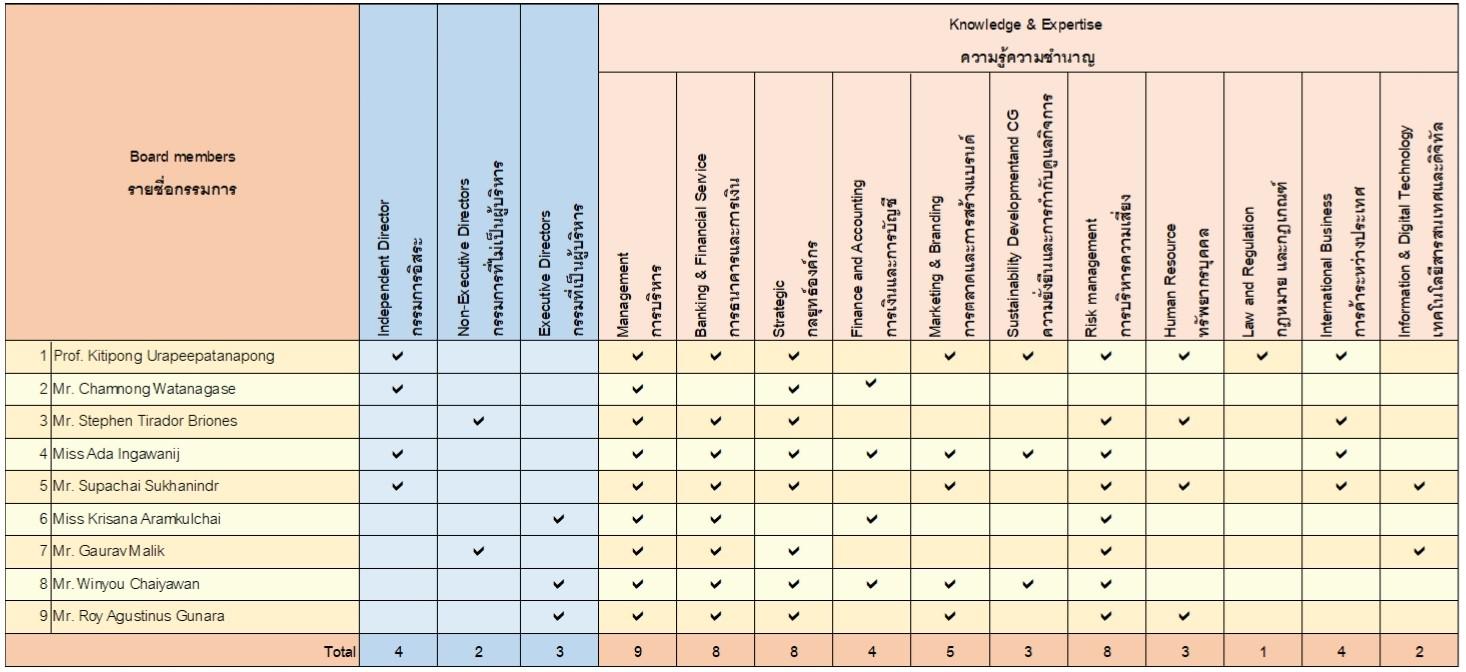
At the Annual General Meeting of Shareholders for the year 2025, the Bank has a total of 9 directors, thus 3 directors are due to retire by rotation, namely:
Prof. Kitipong Urapeepatanapong, Independent Director
Mr. Chamnong Watanagase, Independent Director
Mr. Stephen Tirador Briones, Non-Executive Director
The Board of Directors, excluding interested directors, has approved the recommendations of the Nomination and Remuneration Committee, which has carefully considered the qualifications and suitability beneficial to the Bank's operations, as well as the composition of the Board. It is deemed that the 3 directors due to retire by rotation are fully qualified, possess no prohibited characteristics under current laws applicable to the Bank, and have knowledge, abilities, and experience in the financial business. Therefore, it is proposed that the shareholders' meeting consider re-electing all 3 retiring directors to serve another term as directors of the Bank.
Term of Office for Bank Directors
At the Annual General Meeting of Shareholders, one-third of the total number of the Bank's directors must retire from office. If the number of directors cannot be divided exactly by three, the number closest to one-third shall retire. Directors due to retire shall be those who have held office for the longest period. If, on any occasion, several directors have held office for an equal period, and their number exceeds the number of directors due to retire on that occasion, lots shall be drawn. However, retiring directors may be re-elected. Independent directors shall hold office for a continuous period not exceeding 9 years from the date of their initial appointment as independent directors.
For the term of office of directors on sub-committees, namely the Audit Committee, Risk Oversight Committee, Nomination and Remuneration Committee, Corporate Governance and Sustainable Development Committee, and the Executive Committee, the term of office is 3 years per term and shall align with the term of office of the Bank's directors (in cases where they also serve as Bank directors).
Directorship in Other Companies
To ensure that directors are able to devote sufficient time to the Bank, directors, the Chief Executive Officer, and senior executives may hold the position of chairman or executive director (either or both) in no more than three business groups in other companies, excluding positions held in the Bank, whereby each company not belonging to a business group shall be counted as one business group and companies acquired through debt restructuring shall be counted as part of the Bank’s financial business group unless otherwise directed by the Bank of Thailand, and directors may also serve as directors of other listed companies on domestic or international stock exchanges provided that the total number does not exceed five listed companies, counting the Bank as one listed company but excluding listed companies acquired through debt restructuring unless otherwise directed by the Bank of Thailand.
Directors & Chief Executives — Introduction
Nomination Process for Directors, Chief Executive officer and Senior Executives
Nomination of Directors
The Board of Directors has appointed the Nomination and Remuneration Committee to establish policies and criteria for the nomination of directors and independent directors, including the prescribed qualifications for such positions, taking into account diversity in knowledge, expertise, skills, and experience beneficial to the Bank’s operations and aligned with its business strategy through the Board Skill Matrix, without limitation based on gender, race, religion, age, or other specific characteristics; candidates must be able to fully dedicate their time to performing their duties and must not possess any prohibited characteristics under applicable laws, regulations, and principles of good corporate governance.
Nomination and Appointment of the Chief Executive Officer and Senior Executives
The Board of Directors has assigned the Nomination and Remuneration Committee to identify and nominate suitably qualified persons for appointment as the Chief Executive Officer (CEO), who serves as the highest-ranking executive of the organization, in accordance with established criteria requiring that the candidate possess the requisite qualifications and be free from prohibited characteristics under the regulations of the Securities and Exchange Commission Thailand, the Stock Exchange of Thailand, the Financial Institutions Business Act B.E. 2551 (2008), and other relevant laws and regulations, similar to the nomination process for directors; the CEO must also hold the position of director and have undergone the director nomination process, and the appointment as director and CEO must be submitted respectively to the Bank of Thailand for approval.
For Senior executives are under the responsibility of the Human Resources function, which conducts recruitment through a clear, transparent, and fair process based on qualifications, knowledge, competencies, skills aligned with the Bank’s strategy, and relevant experience appropriate to the position, in consideration of strategic objectives and other applicable criteria to ensure the selection of capable executives able to drive sustainable organizational growth, with interviews conducted by the CEO or submissions made to the Nomination and Remuneration Committee and the Board of Directors for consideration, as appropriate.
Are Directors Selected Through the Nomination Committee?
Yes
Are Chief Executives Selected Through the Nomination Committee?
Yes
Rights of Minority Shareholders on Director Appointment
The Bank has established processes and channels to enable minority shareholders to participate in its governance by providing them with the opportunity to propose agenda items for the Annual General Meeting of Shareholders and to nominate qualified persons for consideration as directors prior to the issuance of the notice convening the 2025 Annual General Meeting of Shareholders. For the 2025 AGM, the Bank allowed shareholders to propose agenda items and nominate director candidates in advance for a period of three months before the end of its fiscal year, from 1 September 2024 to 30 November 2024. The Bank announced this opportunity through the Stock Exchange of Thailand and disclosed the relevant criteria and procedures for proposing agenda items and nominating director candidates on the Bank’s website from 22 August 2024. Shareholders wishing to nominate a person for consideration as a director were required to meet the following qualifications:
Be shareholder(s) of the Bank, either individually or collectively, holding not less than 5 percent of the total voting rights of the Bank, and having held such shares continuously for at least 12 months up to the date of submission.
Be able to provide evidence of shareholding as prescribed by the Bank, such as a certified true copy of share certificates, a confirmation letter issued by a securities company, or other evidence issued by the Stock Exchange of Thailand or Thailand Securities Depository Co., Ltd.
However, no shareholder proposed any agenda item for the 2025 Annual General Meeting of Shareholders or nominated any person for consideration as a director during the specified period.
Method of Director Appointment
| Method |
|---|
| Method whereby each director requires approval votes more than half of the votes of attending shareholders with voting rights |
Selection of Independent Directors
Criteria for Selecting Independent Directors
The Nomination and Remuneration Committee is responsible for screening and assessing qualified and suitable candidates for appointment as independent directors. The Committee considers qualifications in accordance with the relevant laws, the Bank’s Articles of Association, the regulations and notifications issued by the Bank of Thailand, the Securities and Exchange Commission, the Stock Exchange of Thailand, and the principles of good corporate governance.
The Nomination and Remuneration Committee will provide its recommendation to the Bank’s Board of Directors and, as applicable, propose the appointment for approval by the shareholders meeting. The Bank also encourages shareholders, particularly minority shareholders, to nominate qualified individuals for consideration as directors or independent directors in order to promote participation and protect the rights of all groups of shareholders on an equitable basis.
Qualifications of Independent Directors
The Bank has prescribed the qualifications of independent directors in line with the relevant requirements of the Bank of Thailand relating to governance and internal control mechanisms of financial institutions and financial business groups. These qualifications are also consistent with the notifications of the Capital Market Supervisory Board and the principles of good corporate governance. The qualifications of independent directors are as follows.
Must hold no more than 1% of the total voting shares of the Bank, its subsidiaries, its associates, major shareholders, or controlling persons of the Bank. The shareholding of related persons of the independent director must also be included in this calculation.
Must not be or have been a director involved in management, employee, staff member, salaried advisor, or controlling person of the Bank, its subsidiaries, associates, companies under the same group, major shareholders, or controlling persons of the Bank, unless such status has ceased for not less than two years prior to the date of submitting the application to the Office; however, this prohibition shall not apply to cases where the independent director was a government official or an advisor to a government agency which is a major shareholder or controlling person of the Bank. Must not be or have been a director participating in management, an employee, a staff member, an advisor receiving a regular salary, or a controlling person of the Bank, its subsidiaries, its associates, companies of the same group, major shareholders, or controlling persons unless such status has ended for at least two years prior to the date of application for approval.
This prohibited characteristic does not include cases where an independent director was previously a government official or an advisor to a government agency that is a major shareholder or controlling person of the Bank.Must not be a person having a blood relationship or a legal relationship by registration as a father, mother, spouse, sibling, or child, including the spouse of other directors, executives, major shareholders, controlling persons, or persons proposed to be directors, executives, or controlling persons of the Bank or its subsidiaries.
Must not have or have had any business relationship with the Bank, its subsidiaries, associates, major shareholders, or controlling persons of the Bank in a manner that may impair the exercise of independent judgment, and must not be or have been a substantial shareholder or controlling person of any person having a business relationship with the Bank, its subsidiaries, associates, major shareholders, or controlling persons of the Bank, unless such relationship has ceased for not less than two years.
Business relationships include normal commercial transactions for business operations, leasing or letting of immovable property, transactions relating to assets or services, or financial assistance through borrowing, lending, guarantees, or provision of assets as collateral, or other similar arrangements resulting in outstanding liabilities owed by either party amounting to at least 3% of the applicant’s net tangible assets or at least THB 20 million, whichever is lower; the calculation of such liabilities shall follow, mutatis mutandis, the rules on connected transactions prescribed by the Capital Market Supervisory Board, and shall include liabilities incurred within one year prior to the date of the business relationship with the same person.
Must not be or have been an auditor of the Bank, its subsidiaries, associates, major shareholders, or controlling persons of the Bank, and must not be a substantial shareholder, controlling person of the Bank, or a partner of an audit firm which has acted as auditor of the Bank, its subsidiaries, associates, major shareholders, or controlling persons of the Bank, unless such status has ceased for not less than two years.
Must not be or have been a provider of any professional services, including legal or financial advisory services, receiving fees exceeding THB 2 million per year from the Bank, its subsidiaries, associates, major shareholders, or controlling persons of the company, and must not be a substantial shareholder, controlling person, or partner of such professional service provider, unless such status has ceased for not less than two years.
Must not be a director appointed to represent a director of the Bank, a major shareholder, or a shareholder related to a major shareholder.
Must not engage in a business of the same nature that constitutes material competition with the business of the Bank or its subsidiaries, nor be a substantial partner in a partnership, nor be a director involved in management, employee, staff member, salaried advisor, or hold more than 1% of the total voting shares of another company engaging in a business of the same nature and materially competing with the Bank or its subsidiaries.
An independent director must not serve continuously for more than nine years, counting the tenure served as an independent director of the Bank, companies within the Bank’s financial business group, subsidiaries, associates, and companies under the same level of control; if an independent director has completed nine years and wishes to be reappointed, he or she must have ceased to be a director, executive, employee, salaried advisor, or controlling person of the Bank or related entities, major shareholders, or controlling persons for at least two years, while an independent director who has served less than nine years may be reappointed even after a break of less than two years, provided that during such period he or she did not hold any such positions, with the term of service counted on a cumulative and continuous basis.
has no other characteristics that would prevent them from providing independent opinions regarding the bank's operations.
In considering the qualifications of an independent director for the retrospective period, the above criteria shall apply, unless a waiver has been granted pursuant to the notification of the Capital Market Supervisory Board.
After being appointed as an independent director possessing the aforementioned qualifications, the independent director may be assigned by the Board of Directors to make decisions regarding the operations of the Bank, its subsidiaries, associated companies, sister companies, major shareholders, or controlling persons of the Bank, provided that such decisions are made collectively (Collective Decision).
In the case where an individual appointed by the Bank to serve as an independent director has or previously had a business relationship exceeding the value prescribed under Clause 4, the Bank shall obtain an opinion from the Board of Directors indicating that it has considered the principles under Section 89/7 of the Securities and Exchange Act B.E. 2535 (1992), and has concluded that the appointment of such person does not affect the performance of duties or the provision of independent opinions. The Bank shall also disclose the relevant information in the notice of the shareholders’ meeting under the agenda regarding the appointment of the independent director.
Did Any Independent Director Have a Business or Professional Relationship?
No
Director Development
Director Development — Introduction
The Bank encourages its directors and executives to participate in seminars and training courses beneficial to their duties, in order to continuously enhance the skills and knowledge necessary for their responsibilities, in accordance with the established plans and budget. These programs are organized by the Thai Institute of Directors Association, the Stock Exchange of Thailand, or other independent institutions, with the aim of ensuring continuous improvement in performance and applying the acquired knowledge for the benefit of the Bank.
Development of Directors in the Past Year
The Bank prioritizes the continuous promotion and support of training and knowledge development for its directors, particularly in the principles of good corporate governance, as well as other relevant and essential knowledge for the directors' performance of duties, to enhance the effectiveness of the Bank's oversight and management. All Bank directors have successfully completed the fundamental director training courses organized by the Thai Institute of Directors (IOD), accounting for 100% of all directors. In 2025, the Bank's directors received additional training in the following courses:
Qualifications for Director Selection — Introduction
The Bank has prescribed directors’ qualifications in the Board Charter, which may be summarized as follows:
Directors must possess knowledge, competence, and experience beneficial and appropriate to the Bank’s business operations, demonstrate leadership and broad vision, understand the nature of the Bank’s business and be able to view the business holistically, perform their duties and express opinions independently, uphold honesty and integrity with strong business ethics, and be able to devote sufficient time to their responsibilities.
Directors must possess all required qualifications and have no prohibited characteristics as prescribed under the Public Limited Companies Act B.E. 2535 (1992) (as amended), the Securities and Exchange Act B.E. 2535 (1992) (as amended), the Financial Institutions Business Act B.E. 2551 (2008) (as amended), the Payment Systems Act B.E. 2560 (2017), and other applicable laws and regulations, including the notifications of the Bank of Thailand regarding approval criteria for the appointment of directors, managers, persons with management authority, or advisors of financial institutions; directors must not possess any characteristics indicating a lack of trustworthiness as prescribed by the Securities and Exchange Commission Thailand, must obtain approval from the Bank of Thailand, and must be listed in the directors and executives database system of securities issuers in accordance with the relevant Capital Market Supervisory Board notification.
Directors must not engage in, become a partner in, or serve as a director of any other juristic person in Thailand conducting the same and competing business as the Bank or its subsidiaries, whether for their own benefit or that of others, unless prior disclosure is made to the shareholders’ meeting before appointment; directors must also promptly notify the Bank of any direct or indirect interest in contracts entered into by the Bank or of any increase or decrease in their holdings of shares or debentures in the Bank or its affiliated companies.
Directors may serve as chairman or executive director (either or both) in other companies in no more than three business groups, excluding positions held in the Bank; where a company does not belong to a business group, each such company shall be counted as one business group, and companies acquired through debt restructuring shall be counted as part of the Bank’s financial business group, unless otherwise directed by the Bank of Thailand.
Directors may hold directorships in other listed companies on domestic or international stock exchanges, provided that the total number does not exceed five listed companies, counting the Bank as one listed company but excluding listed companies acquired through debt restructuring, unless otherwise directed by the Bank of Thailand.
Qualifications for Director Selection
| Qualification | Skill & Expertise |
|---|---|
| Knowledge and Experience Qualifications | 118 · Description: Banking · 143 · Description: Accounting · 144 · Description: Finance · 165 · Description: Risk Management · 265 · Description: Governance/ Compliance |
Evaluation of Board & Subcommittee Performance
Criteria for Evaluating Board Performance
Performance Evaluation of the Board of Directors, Sub-Committees, and the Chief Executive Officer
Performance Evaluation of the Board of Directors
The Bank’s Board of Directors has a policy requiring annual performance evaluations in two forms: a whole-board evaluation and a cross individual evaluation, while Board committees are evaluated through a committee evaluation and individual self-assessments, in order to review matters undertaken during the year and enhance the effectiveness of the Board’s performance. The Board also requires periodic reviews of the evaluation criteria to ensure they remain appropriate and aligned with the Board’s roles, duties, responsibilities, and good corporate governance practices.
The Board of Directors’ Performance Evaluation (as a whole)
The collective performance evaluation of the Board of Directors follows the framework prescribed by the Stock Exchange of Thailand, with the content refined to ensure appropriateness and alignment with the Board’s authority, duties, and responsibilities, comprising a total of 22 items that assess the Board’s overall roles and performance, including understanding of duties and responsibilities, preparedness and regular meeting attendance, application of knowledge and specialized expertise in providing strategic guidance, raising questions and requesting additional information from management, proposing new ideas and engaging in constructive debate, working collaboratively with mutual respect and openness to differing views, fulfilling governance responsibilities and maintaining checks and balances, expressing opinions or dissent on matters inconsistent with good governance principles, collaborating with management and sub-committees, and recommending organizational development initiatives in response to changes and best practices to enhance long-term effectiveness and sustainability.
The summary of the Board of Director’s assessment as a whole for 2025 reflects an overall average score of 3.87, which is lower than the 2024 average of 3.93.
The individual performance evaluation of the Board of Directors is conducted on a cross-evaluation basis.
The individual performance evaluation of the Bank’s Board of Directors is conducted using a cross-evaluation approach. The self-assessment form for the Board members has been refined to ensure appropriateness and alignment with the specific characteristics of the Bank’s Board. The assessment is divided into five main categories:
(1) Board structure and qualifications, (2) Roles, duties, and responsibilities of the Board, (3) Board meetings, (4) Relationship with management, (5) Directors’ development. Each category comprises several sub-items, totaling 36 criteria, with a scoring scale of 1–4, ranging from strongly disagree to strongly agree. This evaluation reflects the Bank’s commitment to governance responsibilities, with the results grouped into four key dimensions as follows:Mission-Focused
Organization Strategy
Culture of Trust and Respect
Corporate Governance on a Continuum
The summary of the Board of director’s individual cross-evaluation (evaluating fellow directors) for 2025 shows an overall average score of 3.84, which is slightly lower than the 3.85 average score in 2024.
Performance Evaluation of Sub-Committees
The Bank conducts annual performance evaluations of all five sub-committees, namely the Audit Committee, the Nomination and Remuneration Committee, the Risk Oversight Committee, the Corporate Governance and Sustainable Development Committee, and the Executive Committee, with the objective of using the evaluation results to determine appropriate measures for improvement and to further enhance the effectiveness of each sub-committee’s performance, whereby the evaluation criteria and forms differ according to the respective roles, duties, and responsibilities of each sub-committee.
Evaluation of Board Performance in the Past Year
The overall evaluation indicates that the Board of Directors has fully performed its duties in accordance with its assigned roles and responsibilities, within the framework of applicable laws and principles of good corporate governance, while placing emphasis on transparency, accountability, and ethical management. The Board plays a key role in setting the Bank’s direction, strategies, and major policies, overseeing management to ensure effective operations and prudent risk management, conducting regular and effective meetings, making decisions based on comprehensive and well-rounded information, maintaining appropriate relationships with internal and external auditors, and giving due consideration to stakeholders and investors.
Evaluation Results
| Evaluated Body | Group — Carried Out? | Group — Grade / Average Score | Group — Grade / Full Score | Individual (Self-Assessment) — Carried Out? | Cross (Assessing Other Directors) — Carried Out? | Cross (Assessing Other Directors) — Grade / Average Score | Cross (Assessing Other Directors) — Grade / Full Score |
|---|---|---|---|---|---|---|---|
| Board Of Director | Y | 3.87 | 4.00 | N | Y | 3.84 | 4.00 |
Subcommittees
Subcommittees
| Results of the Subcommittee's Duty Performance |
|---|
In 2025, the Risk Management Committee held a total of 11 meetings. The Committee performed its duties in accordance with the scope of responsibilities set out in the Risk Management Committee Charter as approved by the Board of Directors, in alignment with best practices of the Securities and Exchange Commission and the Bank of Thailand. The outcomes of its meetings were reported to the Board of Directors on a monthly basis. A summary of its key activities is as follows: Review of the adequacy and effectiveness of overall risk management policies and strategies. The Committee considered and approved the review of the adequacy and effectiveness of the Bank’s risk management policies, strategies, and risk appetite at least annually or upon any significant changes. It also held discussions with the Audit Committee to ensure that risk management covered all types of risks, including emerging risks, and that such policies were effectively implemented. Risk Management The Committee coordinated with the Audit Committee on key risk and internal control matters to support the consideration of the internal audit plan and to ensure that the Bank maintains appropriate and effective internal control and risk management systems. Review and screen compliance oversight work The Committee reviewed and proposed matters relating to compliance oversight for the Board’s approval, including the review of policies and charters of the Compliance Function, assessment of the effectiveness of compliance risk management, and consideration of the appointment, rotation, performance evaluation, and remuneration of the head of the Compliance Business Unit. Others The Committee annually reviewed its Charter and conducted performance evaluations both collectively and individually, using the results to enhance its effectiveness. The Risk Management Committee performed its duties as assigned by the Board of Directors and in accordance with its Charter with due knowledge, prudence, and independence for the utmost benefit of the Bank. Performance Evaluation of the Risk Oversight Committee as a Whole The collective performance evaluation of the Risk Management Committee follows the evaluation format prescribed by the Stock Exchange of Thailand, with content refined to align with its authority, duties, and responsibilities. The evaluation is divided into three main categories: (1) composition and qualifications, (2) conduct of meetings to ensure effective performance, and (3) roles, duties, and responsibilities. The assessment comprises a total of 13 items. The summary of the Risk Oversight Committee’s assessment as a whole for 2025 reflects an overall average score of 3.89, which is higher than the 2024 average of 3.69. Performance Evaluation of the Individual Risk Oversight Committee The individual self-evaluation form for members of the Risk Management Committee has been refined to align with the specific nature of the Committee’s responsibilities. The key evaluation criteria include preparation and review of materials, expression of opinions and participation in meetings, and effective performance of duties as assigned. The assessment comprises a total of 11 items. The summary of the individual self-assessment of the Risk Oversight Committee for 2025 shows an overall average score of 3.80, higher than the 2024 overall average score of 3.71. |
The Nomination and Remuneration Committee is responsible for supporting the Board of Directors in establishing clear and transparent policies and systems for nomination, remuneration, and other benefits for directors, authorized persons, employees of the Bank, and companies within the financial business group, in accordance with good corporate governance principles. In 2025, the Nomination and Remuneration Committee convened a total of four meetings. The key activities undertaken during the year can be summarized as follows: Nomination
Remuneration
Others
Performance Evaluation of the Nomination and Remuneration Committee as a Whole The performance evaluation of the Nomination and Remuneration Committee as a whole follows the evaluation format prescribed by the Stock Exchange of Thailand, with content refined to align with its authority, duties, and responsibilities. The evaluation is divided into three main categories: (1) structure and qualifications of the Committee, (2) conduct of Committee meetings, and (3) roles, duties, and responsibilities of the Committee. The assessment comprises a total of 23 items. The summary of the Nomination and Remuneration Committee’s assessment as a whole for 2025 reflects an overall average score of 4, which is higher than the 2024 average of 3.70 Performance Evaluation of the Individual Nomination and Remuneration Committee The individual performance evaluation is conducted through a self-assessment form, which has been refined to align with the specific nature of the Committee’s responsibilities. The key evaluation criteria include: (1) structure and qualifications of the sub-committee, (2) conduct of meetings, and (3) roles, duties, and responsibilities of the sub-committee. The assessment comprises a total of 14 items. The summary of the individual self-assessment of the Nomination and remuneration committee for 2025 shows an overall average score of 4, higher than the 2024 overall average score of 3.67. |
The Corporate Governance and Sustainability Committee is responsible for proposing guidelines and providing recommendations to the Board of Directors on matters relating to good corporate governance and sustainable development. Its mandate covers the formulation of scope, policies, and practices relating to environmental, social, employee, and governance matters; the Bank’s Code of Conduct; occupational health and safety; and workplace environment standards. In 2025, the Corporate Governance and Sustainability Committee held a total of four meetings and performed its duties in accordance with the governance and sustainability responsibilities specified in its charter. The key activities undertaken can be summarized as follows: Policy Setting and Development Direction The Committee placed significant emphasis on establishing policies and strategic directions for the Bank’s sustainable development and considered and approved several key policies. Environmental and Climate Change The Committee closely monitored the Bank’s environmental performance. The Bank’s 2024 Carbon Footprint was verified and certified by BSI and received certification under ISO 14064-1, the international standard for organizational greenhouse gas quantification and reporting. The Bank also obtained the Carbon Label Certificate, reflecting its strong commitment to greenhouse gas management and reduction. The Committee acknowledged the greenhouse gas emissions report for the first half of 2025, covering both Scope 1 and Scope 2 emissions, in order to monitor progress toward the established targets. It also followed up on the development of the Environmental and Social Management System (ESMS), under which credit cases are systematically reviewed and screened in accordance with ESG policies. Dedicated working groups were established to further enhance operational standards. In addition, the Bank participated in international climate finance forums and conducted a self-assessment in accordance with the sustainability guidelines issued by the Bank of Thailand to further align its sustainability practices with regulatory expectations. Monitoring and Performance Evaluation Environmental and Climate Change Aspects The Committee closely monitored the progress of environmental operations. The Bank's Carbon Footprint for 2024 was verified and certified by BSI and received certification according to ISO 14064-1, an international standard for quantifying and reporting organizational greenhouse gas emissions. The Bank also received the Carbon Label Certificate, reflecting its strong commitment to managing and reducing greenhouse gas emissions. The Committee acknowledged the greenhouse gas emissions report for the first half of 2025, covering both Scope 1 and Scope 2, to monitor progress towards the set targets. Furthermore, it monitored the development of the Environmental and Social Management System (ESMS), which systematically incorporates loan cases for consultation and screening according to ESG policies, as well as the establishment of specialized working groups to elevate operational standards. The Bank also participated in international activities and forums on climate finance and conducted a self-assessment according to the Bank of Thailand's standards to elevate its sustainability operations in line with regulatory guidelines. Social and Corporate Social Responsibility The committee monitored the progress of the Tang To Know-how project, the Bank’s flagship financial literacy initiative. Over the past nine years, the project has created tangible positive social impacts, with a total of 308,782 participants completing the training across 7,566 activities held in all 76 provinces nationwide. In 2025, the Bank expanded the project by launching a financial literacy campaign under the concept “Reduce Debt, Gain Funds, Grow Business,” organizing activities across five regions of the country. In 2025, the project welcomed a total of 68,444 participants, exceeding the target of 66,000 participants. The effectiveness assessment of the project shows that participants demonstrated tangible improvements in their financial behavior. A total of 63% of trainees exhibited better financial habits, such as recording income and expenses, saving money, and financial planning. Moreover, 97% of trainees applied the knowledge gained from the training. At the business level, 60% of participating entrepreneurs reported increased sales after applying the knowledge, and 89% demonstrated good debt repayment behavior. The project also received high satisfaction and referral rates of up to 80%. The Bank has developed digital innovations to enhance its services by transforming knowledge transfer into tangible changes. It has developed three toolsets on the Micro Pay e-wallet platform, consisting of: (1) Tang To Biz Health, for assessing overall business health with a score ranging from 0–100; (2) Tang To Biz X-Ray, for analyzing markets and business strategies using AI; and (3) Tang To Biz Pro, for systematic business planning and performance management. The Bank has also developed seven e-Learning courses for employees to enhance their financial knowledge and understanding, benefiting 526 employees prior to providing services to customers. The Board acknowledged the progress of the “Thai Credit Building a Sustainable Future: Empowering Community Development” project. The Bank has implemented pilot community development plans in three areas: (1) Lam Hoei Subdistrict, Don Tum District, Nakhon Pathom Province; (2) Bangkok; and (3) Chachoengsao Province. In the third year of the project, the model community included 40 households participating in the organic farming program, with 402 participants joining the learning center. The initiative generated an additional annual income of 39,525 baht for the community. The Bank has established a strategic partnership network comprising 50 leading organizations, including 14 government agencies and state enterprises, 7 private-sector entities, 10 fresh-market operator groups, 5 universities, and 14 educational institutions. Notable strategic partners include SCG Packaging, which supports the dissemination of knowledge and best practices in Circular Economy, and C.J. Express, which facilitates the preparation of entrepreneurs for entry into modern retail markets. In addition, the Bank organized employee volunteer activities that created tangible value for society. A total of 1,364 employee volunteers contributed 12,270 volunteer hours. The Bank also implemented debtor assistance programs and established policies to protect employees from customer harassment, thereby fostering a safe and supportive working environment. The Bank’s outstanding social performance has been recognized by external organizations. For the second consecutive year, the Bank received an honorary award for its pioneering role in promoting financial discipline from the Federation of Business and Professional Women’s Associations of Thailand under Royal Patronage. Governance and Reporting The committee monitored the preparation of the Sustainability Report, which is developed in accordance with the standards of the Stock Exchange of Thailand and aligned with international reporting principles (GRI Standards) and the United Nations Sustainable Development Goals (SDGs), to transparently and comprehensively disclose sustainability performance to stakeholders. The committee acknowledged the results of the Corporate Governance Report (CGR) assessment for Thai listed companies for 2025, in which the Bank received a score of 94 out of 100, achieving the “Excellent” level for the second consecutive year. This reflects the Bank’s commitment to continuously advancing corporate governance standards towards excellence. The committee also acknowledged the Bank of Thailand’s sustainable development guidelines for financial institutions, which emphasize the importance of building a sustainability identity based on each institution’s strengths, and encourage financial institutions to undergo international standard assessments to enhance their operations. Recommendations and Key Observations The Committee provided significant recommendations to the Board of Directors and Management, emphasizing that the Bank should further strengthen its ESG culture and embed it across all levels of the organization through structured training programs and by incorporating sustainability targets into key performance indicators (KPIs). This approach would ensure that sustainability becomes an integral part of the Bank’s day-to-day business operations. The Committee also recommended that the Bank consider undergoing an international assessment, such as by FTSE Russell, within 2026 to elevate its operational standards to the international level and enhance credibility among global institutional investors. The Committee recognized the Bank’s distinctive strength in the social dimension, particularly its financial literacy initiatives that have continuously generated tangible positive social impact. It therefore recommended building a clear sustainability identity upon this strength and expanding such programs to broader target groups, especially vulnerable segments such as youth and the elderly, through the development of tailored curricula. From a risk management perspective, the Committee advised the Bank to accelerate the enhancement of its Environmental and Social Management System (ESMS) to achieve maximum effectiveness and to further integrate ESG factors systematically into the credit approval process. It also recommended expanding collaboration with strategic partners, such as ThaiNamthip Limited, to strengthen environmental initiatives, particularly in plastic bottle management and the promotion of a circular economy, thereby ensuring that community development programs are comprehensive across all sustainability dimensions. Others The committee reviewed the Charter of the Corporate Governance and Sustainability Committee for 2025 to ensure its relevance and alignment with current operations. The revised charter was submitted to the Bank’s Board of Directors for approval at Meeting No. 9/2025 on September 23, 2025. In summary, in 2025, the Corporate Governance and Sustainability Committee fully and effectively performed its duties in accordance with the responsibilities outlined in the charter. The Committee placed strong emphasis on overseeing and promoting compliance with good corporate governance principles and advancing sustainability across environmental, social, and governance dimensions, as well as providing strategic recommendations to the Bank’s Board of Directors and management. The Bank has made significant progress in advancing its sustainability initiatives by establishing clear climate-related targets, strengthening its Environmental and Social Management System, and continuously driving corporate social responsibility programs. These efforts have been recognized by external organizations, reflecting the Bank’s strong commitment to creating sustainable value for all stakeholders:
The Corporate Governance and Sustainability Committee has performed its duties as assigned by the Board of Directors, in alignment with the responsibilities stipulated in its Charter. The Committee has applied its knowledge and expertise in carrying out its duties with due care, independence, transparency, and adherence to principles of integrity and propriety. It has also provided constructive opinions and recommendations without limitation in accessing information, resources, and cooperation from the Bank, with due regard to equitable treatment of stakeholders and with the paramount objective of safeguarding the best interests of the Bank and its stakeholders. The Committee will continue to closely monitor and support the Bank’s corporate governance and sustainability initiatives on an ongoing basis to ensure that the Bank achieves stable and sustainable growth, while upholding its role as a financial institution that demonstrates genuine social and environmental responsibility, in line with the “Everyone Matters” philosophy and its commitment to serving as a partner in the country’s sustainable development. Performance Evaluation of the Corporate Governance and Sustainable Development Committee as a Whole The performance evaluation form for the entire Corporate Governance and Sustainable Development Committee follows the Stock Exchange of Thailand's assessment format. Its content has been adjusted to be appropriate and consistent with the powers and responsibilities of the Corporate Governance and Sustainable Development Committee. It is divided into two main categories: (1) Self-assessment and (2) Group assessment, with a total of 14 questions and a scoring scale of 1-4, ranging from strongly disagree to strongly agree. The summary of the Corporate Governance and Sustainable Development Committee’s assessment as a whole for 2025 reflects an overall average score of 3.81, which is similar to the 2024 overall average score of 3.90. Performance Evaluation of the Individual Risk Oversight Committee The Corporate Governance and Sustainable Development Committee conducted individual performance evaluations through self-assessment. The self-assessment form for individual members of the Corporate Governance and Sustainable Development Committee has been revised to be appropriate and consistent with the specific characteristics of the Committee. The main assessment topics include personal qualifications, readiness to perform duties, participation in offering specialized knowledge and beneficial opinions for operations, roles, duties, and responsibilities. There are a total of 17 questions, with a scoring scale of 1-4, ranging from strongly disagree to strongly agree. The summary of the individual self-assessment of the Corporate Governance and Sustainable Development Committee for 2025 shows an overall average score of 3.53, which is similar to the 2024 overall average score of 3.78. |
The Executive Committee is responsible for overseeing the Bank’s operations to ensure alignment with its objectives, Articles of Association, policies, regulations, strategies, and business plans in order to achieve the established targets. The Committee is also responsible for implementing the policies, strategic directions, and sound risk governance framework—including various policies approved by the Board of Directors with strict adherence, and for regularly reporting progress to the Board to ensure consistency with the policies, objectives, and strategies prescribed and delegated by the Board. This structure enhances operational agility while alleviating the Board’s responsibilities. In 2025, the Executive Committee convened a total of 13 meetings and undertook key actions as summarized below:
Performance Evaluation of Executive Committee as a Whole The performance evaluation of the Executive Committee as a whole is conducted in accordance with the Stock Exchange’s evaluation framework, with the assessment form revised to ensure its appropriateness and alignment with the authority, duties, and responsibilities of the Executive Committee. The evaluation is divided into three main categories: (1) Composition and qualifications of the Executive Committee; (2) Conduct of Executive Committee meetings to ensure the effective discharge of duties; and (3) Roles, duties, and responsibilities of the Executive Committee. The assessment comprises a total of 14 items. The summary of the Executive Committee’s assessment as a whole for 2025 reflects an overall average score of 3.92, which is higher than the 2024 average of 3.91. Performance Evaluation of the Individual Executive Committee The individual performance evaluation is conducted through a self-assessment process. The self-assessment form for individual members of the Executive Committee has been revised to ensure its appropriateness and alignment with the specific roles and responsibilities of the Executive Committee. The key evaluation criteria include preparation and review of materials prior to meetings, provision of opinions and active participation in discussions, and the effective discharge of duties as assigned. The assessment comprises a total of 11 items.. The Summary of the individual self-assessment of the Executive Committee for 2025 shows an overall average score of 3.80, which is lower than the 2024 overall average score of 3.71. |
Meeting Attendance & Remuneration
Meeting Attendance & Remuneration — Introduction
The Bank schedules monthly Board of Directors meetings, and the Corporate Secretary informs all directors of the annual meeting calendar in advance. Additional Board meetings may be arranged as necessary. The Corporate Secretary distributes the meeting notice, agenda, and supporting documents to all directors at least 7 days prior to the meeting to allow sufficient time for review, except in urgent cases. The meeting agenda is categorized clearly and includes regular updates on the Bank’s performance. Every director is required to attend all Board meetings, or no less than 75% of the total number of meetings held each year, unless there is a necessary reason.
During the meetings, the Chairman allocates adequate time for discussion and encourages all directors to express their views freely. Relevant senior executives may be invited to participate in the meeting to provide additional information. Directors may attend the meetings in person or via electronic means. The Bank prepares written minutes that comprehensively capture key matters discussed, finalizes them in a timely manner, and maintains approved minutes in an organized manner for reference.
In addition, the Board of Directors requires that a meeting of non-executive directors be held at least once a year to discuss matters related to the Bank’s business, including topics of particular interest or concern. Such a meeting was held on 20 December 2025.
In 2025, the Board of Directors held a total of 12 meetings, along with 1 meeting exclusively for non-executive directors (without management) in December. This meeting enabled non-executive directors to exchange views independently. After the meeting, the key discussion points were summarized and reported to the Board of Directors for acknowledgment, serving as a basis for more effective monitoring of management’s performance. Furthermore, the Bank holds Executive Committee meetings every month, in which executive directors and most senior executives participate unless urgent obligations prevent attendance. At each meeting, the Chairman of the Executive Committee presides over the session, ensuring that each agenda item is considered thoroughly. All executives are encouraged to express their opinions and participate in discussions, and relevant information is clarified before proceeding to a resolution. Written minutes are prepared for every meeting and stored systematically for audit purposes.
The Bank’s Board of Directors has a policy prohibiting directors and executives who are related parties or who have a conflict of interest concerning any agenda item from attending or voting on that matter. Determination of related parties and conflicted individuals is based on the declarations of interest, which all directors and executives are required to submit as specified, to ensure proper disclosure of conflicts of interest.
Additionally, the Board has established a policy on meeting quorum requirements. For any resolution to be passed at a Board meeting, at least two-thirds of all Board members must be present.
Justification for Directors' Non-Attendance
Mr. Winyou Chaiyawan was absent from one meeting due to other commitments.
Types of Remuneration of the Board of Directors
The Bank considers directors’ remuneration with reference to industry practices, ensuring that compensation is appropriate and aligned with the roles, duties, and responsibilities of directors, and sufficient to attract and retain qualified individuals who are dedicated to creating value for the Bank. The Nomination and Remuneration Committee reviews directors’ remuneration annually and proposes it to the Board of Directors for consideration and approval, before submitting it to the Annual General Meeting of Shareholders for further approval. The structure of directors’ remuneration consists of both monetary and non-monetary components, as follows:
Monetary compensation
Monthly remuneration: A fixed monthly payment made to the Chairman, directors, and sub-committee chairpersons, the Chairman of the Audit Committee, during their term of office.
Meeting allowance: Paid to the Chairman and directors for each attendance at Board and sub-committee meetings, on a per-meeting basis.
Special remuneration: An annual payment determined based on the Bank’s operating performance for each year.
Non-monetary compensation
Group medical insurance and annual health check-ups under the same rates and conditions as those provided to senior executives.
However, directors or sub-committee members who are executive directors, executives, or full-time employees of the Bank and already receive regular monthly remuneration are not entitled to monthly directors’ remuneration, meeting allowances, or special remuneration in their capacity as directors or sub-committee members.
Details of Directors’ Remuneration
The Annual General Meeting of Shareholders for the year 2025, held on 28 April 2025, resolved to approve the remuneration of the Board of Directors and five sub-committees, namely: 1) the Board of Directors; 2) the Audit Committee; 3) the Risk Oversight Committee; 4)the Nomination and Remuneration Committee; and 5) the Corporate Governance and Sustainability Committee
Position | 2025 | |
Compensation Monthly (Baht/month) | Meeting allowance (1) (Baht/time/person) | |
Board of Directors | ||
Chairman | 200,000 | 70,000 |
Vice Chairman | 190,000 | 60,000 |
Director | 100,000 | 40,000 |
Audit Committee | ||
Chairman | 60,000 | 50,000 |
Director | 30,000 | 30,000 |
Nomination and Remuneration Committee | ||
Chairman | None | 50,000 |
Director | None | 30,000 |
Risk Oversight Committee | ||
Chairman | None | 50,000 |
Director | None | 30,000 |
Corporate Governance and Sustainability Committee | ||
Chairman | None | 50,000 |
Director | None | 30,000 |
Executive Committee | ||
Chairman of Executive Committee | 500,000 | 100,000 |
Director | None | None |
Note:
(1) The aforementioned meeting allowance is paid for attending Board of Directors meetings; directors will not receive meeting allowances for shareholder meetings.
(2) Executives who are employees and receive a regular salary will not receive compensation as bank directors.
Table showing changes in ordinary shareholding (1) Bank of Directors
No. | List of Directors | Number of ordinary shares held | Change: Increase/Decrease (shares) | Shareholding proportion in the bank (%) | |
December 31, 2024 | December 31, 2025 | ||||
1 | Prof. Kitipong Urapeepatanapong | 34,400 | 34,400 | - | 0.00 |
2 | Mr. Chamnong Watanagase | 103,400 | 103 ,400 | - | 0.01 |
3 | Mr. Stephen Tirador Briones | 10,300 | 15,300 | 5,000 | 0.00 |
4 | Ms. Ada Ingawanij | 86,200 | 86,200 | - | 0.01 |
5 | Mr. Supachai Sukhanindr | 10,000 | 10 ,000 | - | 0.00 |
6 | Ms. Krisana Aramkulchai | 103,400 | 103 ,400 | - | 0.01 |
7 | Mr. Gaurav Malik | - | - | - | - |
8 | Mr. Winyou Chaiyawan(2) | 60,300,690 | 60 ,300,690 | - | 4.88 |
9 | Mr. Roy Augustinas Gunara(3) | 45,701,176 | 45,701,176 | - | 3.70 |
Note:
(1) Including shares of spouse and minor children.
(2) Mr. Winyou Chaiyawan holds 60,300,690 shares in his own name and 19,145,000 shares through a custodian named UBS AG SINGAPORE BRANCH, totaling 79,445,690 shares, representing 6.43%.
(3) Mr. Roy Agustinus Gunara holds 1,000,000 shares in his own name, 44,701,176 shares belonging to his spouse, and 482,300 shares through NVDR, totaling 46,183,476 shares, representing 3.74%.
Remuneration of the Board of Directors
Remuneration or Benefits Payable to the Board
| Metric | Amount (Baht) |
|---|---|
| Remunerations or benefits pending payment to the board of directors over the past year (baht) | 0 |
Supervision of Subsidiaries & Associated Companies
Does the Company Have Subsidiaries or Associated Companies?
Yes
Is There a Mechanism for Overseeing Subsidiaries and Associated Companies?
Yes
Mechanism for Overseeing Management of Subsidiaries
The Bank has established an investment policy focusing on companies that support its business operations and align with its objectives, vision, and strategic growth plans, with the aim of enhancing operating results and profitability, creating business synergies, strengthening competitiveness, and achieving its goal of becoming a leading operator in its core businesses; in this regard, the Bank, its subsidiaries, and/or its associates may also consider investments in other businesses with strong growth potential or the ability to expand or complement the Bank’s operations, provided that such investments generate appropriate returns, and any proposed investment will be subject to a feasibility study and comprehensive analysis covering potential, investment proportion, expected returns, and associated risks, and must obtain approval and/or endorsement from the Board of Directors and/or the shareholders’ meeting, as applicable, while fully complying with the relevant regulations and notifications of the Bank of Thailand, the Capital Market Supervisory Board, and the Stock Exchange of Thailand.
Principles for Governing the Operations of Subsidiaries and Associates Companies
The Bank shall appoint individuals to serve as its representatives as directors and/or executives in each subsidiary and/or associate at least in proportion to its shareholding in each company, to the extent practicable, unless the Board of Directors determines that having representatives in a number lower than its shareholding proportion does not affect the Bank’s authority to determine policies and take action on significant matters or matters materially impacting the financial position and operating results of such company, or that an appropriate balance of power is maintained; in this regard, the Board shall consider and approve such appointments based on the appropriateness of each company, except where a subsidiary or associate is a small company that is not material to the Bank’s financial position and operating results, in which case the Board may delegate the Chief Executive Officer or the President to appoint the Bank’s representatives, with the objective of ensuring that the operations of the subsidiaries and/or associates comply with applicable laws, the Bank’s corporate governance policy, and other relevant policies, and to enable the Bank to acknowledge and monitor their operations to the extent permitted by law and under the relevant policies.
The Bank shall supervise the conduct of its representatives in each subsidiary and/or associate company to ensure that their duties are performed in compliance with applicable laws, the company’s objectives and articles of association, resolutions of the board of directors and shareholders’ meetings, as well as in accordance with good corporate governance practices and business ethics—with integrity, prudence, responsibility, and professionalism.
The Bank shall also monitor and provide recommendations to ensure that the operations of subsidiaries and/or associates align with established objectives and that obstacles or issues can be addressed in a timely and appropriate manner.The Bank shall take all necessary actions, to the extent practicable, to ensure that its subsidiaries and/or associate companies disclose to the Bank their financial position and operating results, transactions that may involve conflicts of interest, and other material information. This also includes ensuring that such subsidiaries and/or associates fully disclose all information required to be submitted to regulatory authorities and relevant government agencies.
The Bank shall closely monitor the performance and operations of its subsidiaries and/or associate companies, and shall provide comments or recommendations to the Bank’s Board of Directors and to the boards of directors of such subsidiaries and/or associates (to the extent practicable). This is to support their consideration of improvements and initiatives that promote continuous development and sustainable growth of the businesses of the subsidiaries and/or associates.
Directors of subsidiaries and/or associates who serve as representatives of the Bank must review, monitor, and provide necessary recommendations to ensure that subsidiaries and/or associates establish clear, efficient, and effective operational systems to support their business activities.
Additional Operational Governance Practices Applicable to Subsidiaries
If a subsidiary enters into a transaction that falls under the acquisition or disposal of assets or a connected transaction according to the relevant announcements of the Capital Market Supervisory Board and the Stock Exchange of Thailand, which would result in the Bank being obliged to seek approval for such transaction from the Bank's Board of Directors meeting and/or the Bank's shareholders' meeting (as the case may be), and/or results in any transaction for which the Bank must obtain approval from relevant legal authorities before entering into it, the subsidiary may only enter into such transaction after receiving approval from the Bank's Board of Directors meeting and/or the Bank's shareholders' meeting and/or relevant authorities (as the case may be).
If the entering into any transaction or the occurrence of any event by a subsidiary results in the Bank having an obligation to disclose information under applicable notifications, regulations, and requirements to relevant regulatory authorities, including the obligations under the Stock Exchange of Thailand’s regulations on the rules, conditions, and procedures for the disclosure of information and the performance of acts by listed companies, the directors and/or executives who serve as representatives of the Bank shall immediately notify the Bank upon becoming aware that such subsidiary has a plan to enter into such transaction or that such event has occurred.
The Bank has established a policy requiring its subsidiaries to maintain appropriate and sufficient risk management and internal control systems, ensure adequate personnel to effectively implement such systems in order to prevent fraud, and put in place internal control mechanisms at both the Bank and subsidiary levels to monitor and oversee subsidiary operations, safeguard assets from misuse or unauthorized use by directors or executives, and adequately supervise transactions involving potential conflicts of interest or connected persons, with oversight conducted through regular audits by the Bank’s Internal Audit function to enable the Board of Directors and management to effectively monitor operating performance, financial position, intercompany and material transactions, while also granting the Bank’s internal auditors and Audit Committee direct access to subsidiaries’ internal information and requiring audit findings to be reported to the Board of Directors to ensure strict compliance with established systems and procedures.
Directors of subsidiaries who serve as representatives of the Bank must ensure that the annual budget of the subsidiary is submitted to the Bank’s Board of Directors for consideration and approval before the subsidiary holds its own board meeting to approve its annual budget, except in cases where such authority has already been delegated under the subsidiary’s Delegation of Authority that has been approved by the Bank’s Board of Directors.
Oversight Mechanisms
| Mechanism |
|---|
| Sending representatives to act as directors, executives or controlling persons in proportion to shareholdings |
| Defining the scope of powers, duties and responsibilities of directors and executives who represent the company in setting important policies |
| Disclosure of financial information and operating results |
| Transactions between the Company and related persons |
| Other important transactions |
| Acquisition or disposal of assets |
| Internal control system of the subsidiary operating the core business is appropriate and sufficient in the subsidiary operating the core business |
Board Duty Performance — Overview
Board Duty Performance — Overall Description
In 2025, the Bank's Board of Directors reviewed the Vision, Mission, Objectives, and Core Values, taking into account various factors including changes in the business environment, future trends, and market competition. This review was conducted to ensure they are current and aligned with Thai Credit Bank's business direction, and to oversee, review, and monitor the management's operations to ensure they adhere to the established policies, strategies, and business plans efficiently and effectively, in compliance with relevant laws, regulations, and stipulations of regulatory bodies.
Audit Committee Duty Performance
Results of the Audit Committee's Duty Performance in the Past Year
The Audit Committee performed its duties in accordance with the scope of responsibilities set out in the Audit Committee Charter as approved by the Board of Directors, which aligns with best practices of the Office of the Securities and Exchange Commission and the Bank of Thailand, and reported the results of its meetings to the Board on a monthly basis, with key matters summarized as follows:
Oversight of Financial Reporting and External Auditors
The Audit Committee reviewed the quarterly, semi-annual, and annual financial statements together with management and the external auditor to ensure compliance with the standards and requirements of the Bank of Thailand. The Committee also met with the external auditor without management present to assess independence and key risk matters. In 2025, no significant observations were noted, except for an issue concerning the management of privileged user accounts, which has already been rectified.
Review of Internal Control Systems and Supervision of Internal Audit
The Committee oversees the internal control system through reports from various functions, including assessments based on the COSO framework and investigation reports concerning fraud cases. It follows up on corrective actions in response to observations raised by relevant parties, approves the internal audit plan, ensures the adequacy of resources and independence of the internal audit function, and regularly evaluates audit quality.
Support for Corporate Governance
The Committee acted as a channel for complaints and whistleblowing reports in order to address conduct that may violate laws, regulations, or the Bank’s code of conduct.
Compliance Oversight
The Committee ensured that the Bank complied with applicable laws and regulatory requirements of key supervisory authorities, such as the Bank of Thailand and the Securities and Exchange Commission, by continuously monitoring internal and external audit reports as well as compliance reviews.
Coordination and Review of Risk Management Systems
The Committee coordinated with the Risk Oversight Committee to monitor key risks and used such information to guide internal audit activities. It assessed the adequacy of risk management based on reports from relevant functions and followed up on corrective actions.
Review of Related Party Transactions and Conflict of Interest Transactions
The Committee carefully reviews related party transactions and transactions that may give rise to conflicts of interest before proposing them to the Board of Directors, ensuring transparency, reasonableness, and the Bank’s best interests, along with accurate disclosure.
Consideration of Appointment and Remuneration of External Auditors
The Committee considers the qualifications, independence, expertise, and performance of the external auditor in accordance with the criteria of the Bank of Thailand and the Securities and Exchange Commission, and proposed the appointment of KPMG Phoomchai Audit Ltd. as the external auditor for 2025 with appropriate remuneration. It also reviews the provision of non-audit services to safeguard auditor independence.
Other Activities
The Committee regularly reviews the Audit Committee Charter and conducts performance evaluations both collectively and individually to enhance effectiveness, performing its duties with due care, prudence, transparency, and independence for the utmost benefit of the Bank and its stakeholders.
The performance evaluation of the Audit Committee as a whole
The performance evaluation of the Audit Committee as a whole followed the Stock Exchange’s evaluation framework, with adjustments made to align with the Committee’s authority, duties, and responsibilities. The evaluation covered four key categories: (1) composition and qualifications, (2) authority, (3) duties and responsibilities, and (4) meetings, comprising a total of 20 items.
The summary of the Audit Committee’s collective self-assessment for 2025 shows an overall average score of 4.00, which is higher than the 2024 average score of 3.98.
The Performance Evaluation of Individual Audit Committee Members
The Audit Committee also conducted individual self-evaluations using a revised assessment form tailored to the Committee’s specific roles. The evaluation covered key areas such as understanding of roles and responsibilities, participation in meetings, contribution of opinions, and provision of recommendations, comprising 16 items.
The summary of the individual self-assessment of the Audit Committee members for 2025 shows an overall average score of 3.98, which is lower than the 2024 average score of 4.00.