

Sustainability · 2025
In this section58 topics
- Sustainability Policy3 items
- Sustainability Goals & UN SDGs4 items
- Policy Review4 items
- Business Value Chain1 item
- Stakeholder Analysis2 items
- Environmental Sustainability — Overview1 item
- Environmental Policy & Guidelines5 items
- Environmental Policy Review3 items
- Energy — Plan & Guidelines2 items
- Energy — Electricity Consumption1 item
- Energy — Fuel Consumption1 item
- Energy — Targets3 items
- Energy — Performance & Outcomes2 items
- Water Management — Overview1 item
- Water — Plan & Guidelines2 items
- Water — Withdrawal, Discharge & Consumption1 item
- Water — Targets2 items
- Water — Performance & Outcomes2 items
- Waste Management — Overview1 item
- Waste — Plan & Guidelines2 items
- Waste — Generation, Disposal & Recycling1 item
- Waste — Targets2 items
- Waste — Performance & Outcomes2 items
- Greenhouse Gas — Overview1 item
- GHG — Plan & Guidelines2 items
- GHG — Emissions1 item
- GHG — Emissions Verification3 items
- GHG — Principles & Standards2 items
- GHG — Targets1 item
- GHG Targets — Net Zero2 items
- GHG Targets — Carbon Neutrality2 items
- GHG — Performance & Outcomes2 items
- Environmental Legal Incidents1 item
- Social Sustainability — Overview1 item
- Social Policy & Guidelines4 items
- Social Policy Review3 items
- Social — Principles & Standards Practised2 items
- Human Rights Due Diligence3 items
- Employees — Plan & Guidelines4 items
- Employees — Workforce1 item
- Employees — Remuneration & Provident Fund1 item
- Employees — Training & Development1 item
- Employees — Occupational Health & Safety1 item
- Employees — Labour Relations1 item
- Employees — Employee Representation3 items
- Employees — Targets2 items
- Employees — Performance & Outcomes3 items
- Customer Management — Overview1 item
- Customers — Plan & Guidelines3 items
- Customers — Satisfaction Results1 item
- Customers — Targets2 items
- Customers — Performance & Outcomes1 item
- Community & Social — Plan & Guidelines5 items
- Community & Social — Targets3 items
- Community & Social — Performance & Outcomes3 items
- Other Social Management3 items
- Law Violation Incidents1 item
- Law Violations — Case Detail & Corrective Measures1 item
Sustainability Policy
Introduction
Thai Credit Bank Public Company Limited (the “Bank”) adheres to its vision and mission of conducting business based on sustainable growth by delivering the best financial services to empower customers and entrepreneurs through accessible financial solutions, while advancing social and environmental sustainability in accordance with its philosophy, “Everyone Matters.” This commitment encompasses all three dimensions of Environment, Social, and Governance (ESG), underpinned by good corporate governance and appropriate risk management.
The Bank places importance on managing and conducting its business with integrity, transparency, and fairness, in alignment with good corporate governance principles, while upholding its responsibilities toward society and the environment under its Market Conduct policy and Responsible Lending approach throughout the customer journey to support sustainable business growth. The Bank is committed to developing differentiated, simple, and transparent products, and has established policies, measures, and systems to prevent and manage conflicts of interest, as well as to supervise, monitor, and ensure compliance with such policies, measures, and systems.
Has a Sustainability Policy
Yes
Policy Description
The Bank is committed to conducting its business based on sustainability principles by integrating environmental, social and employee, and governance (ESG) dimensions into its strategy, operational processes, and corporate culture to achieve responsible long-term growth for all stakeholder groups. Since 2019, the Bank has been a signatory to a cooperation agreement with the Thai Bankers’ Association and 15 commercial banks to establish guidelines on Responsible Lending, and has consistently adhered to these principles by incorporating ESG factors into credit policy formulation, strategy setting, and credit risk management.
Governance is driven under the principle of “Tone from the Top,” with senior management playing an active role in advancing sustainability policies and encouraging stakeholder engagement to ensure alignment with ESG standards and to mitigate both direct and indirect impacts arising from lending activities. The Bank has established systems, policies, and mechanisms to ensure effective implementation across credit origination, risk management, and human capital development, under sound corporate governance practices. In addition, the Bank emphasizes transparency by publicly disclosing information on social and environmental responsibility, reaffirming its commitment to being a transparent and accountable organization.
On the environmental dimension, the Bank focuses on reducing climate-related impacts and enhancing standards for greenhouse gas emissions data management, while setting long-term targets such as Carbon Neutrality by 2050 and Net Zero emissions by 2065.
The Bank believes that operating under ESG principles creates shared value for customers, communities, stakeholders, and the overall economy, while driving strong and sustainable business growth under the corporate philosophy of “Everyone Matters.”
Sustainability Goals & UN SDGs
Introduction
The Bank places strong emphasis on promoting sustainability across three dimensions of ESG: Environment, Social and Employee, and Governance, through the operations of the Bank and the conduct of all employees. The Bank is committed to achieving sustainable long-term growth for both the business and society by conducting its business responsibly toward the environment, society, and employees, and under the principles of good corporate governance, thereby advancing sustainable banking operations.
Has Sustainability Goals
Yes
Goals Description
As a bank serving as a financial institution for the public and the business sector, the Bank recognizes its important role in strengthening the economic and social system. Accordingly, the Bank’s sustainability goals focus on creating tangible social outcomes alongside the provision of financial services that are responsible, transparent, and fair to all customer groups.
The Bank places great importance on enhancing financial literacy, believing that knowledge is the foundation of economic stability and quality of life. Therefore, the Bank has set a goal to expand financial literacy programs to reach youth, the elderly, small entrepreneurs, and vulnerable groups, enabling everyone to plan their finances and use financial services with confidence and safety.
In addition, the Bank is committed to promoting inclusive access to financial services by reducing barriers for groups that have not yet fully accessed the financial system, while maintaining strong consumer protection standards to build trust in every interaction and transaction.
The Bank believes that sustainable development is not merely a goal, but a continuous process of co-creating long-term value for society. As such, the Bank continues to develop its people, work processes, and financial products to respond to global changes and the evolving needs of the public. With this commitment, the Bank is ready to be part of driving Thai society toward sustainable strength, stable growth, and shared opportunities for everyone to move forward together into the future.
Environmental Sustainability Goals
Achieve carbon neutrality by 2050.
Achieve net zero greenhouse gas emissions by 2065.
Social and Community Sustainability Goals
Promote financial literacy for society and communities through the Tang To Know-how program, with a target of 10% annual growth in the number of participants.
Governance Sustainability Goals
Receive an “Excellent” rating in corporate governance from an external assessor.
Obtain certification as a member of Thailand’s Private Sector Collective Action Against Corruption.
UN Sustainable Development Goals
| SDG Goal |
|---|
| Goal 1 No Poverty |
| Goal 3 Good Health and Well-being |
| Goal 4 Quality Education |
| Goal 5 Gender Equality |
| Goal 6 Clean Water and Sanitation |
| Goal 7 Affordable and Clean Energy |
| Goal 8 Decent Work and Economic Growth |
| Goal 9 Industry, Innovation and Infrastructure |
| Goal 10 Reduce Inequalities |
| Goal 11 Sustainable Cities and Communities |
| Goal 13 Climate Action |
| Goal 16 Peace, Justice and Strong Institutions |
| Goal 17 Partnerships for the Goals |
Policy Review
Introduction
The Bank places great importance on regularly reviewing its sustainability policy at least once a year to ensure alignment with rapidly changing economic, social, and environmental contexts. This review process enables the Bank to assess the effectiveness of its operations in the previous year, identify areas for improvement, and explore new opportunities to create shared value for all stakeholder groups.
As part of the review process, the Bank also considers regulatory trends, international standards, and the expectations of customers and society, in order to update and enhance its policy framework to remain relevant and supportive of long-term sustainable development. The outcomes of the review reflect the Bank’s strong commitment to conducting business responsibly, transparently, and with due consideration of impacts across all dimensions.
The Bank believes that continuous policy review is a key driver in building trust and steering the organization steadily toward achieving its sustainability goals in the future.
Policy Reviewed This Year
Yes
Policy Changed This Year
No
Review Details
The Bank reviews its policies on Environment, Social & Employee, and Governance (ESG) for Sustainable Banking at least once a year, as well as whenever there are changes relevant to practices, laws and regulations, or business operations.
On 26 August 2025, the Bank’s Board of Directors approved the review of the Environmental, Social & Employee, and Governance (ESG) Policy to serve as a guiding framework for advancing Sustainable Banking. Following the review, the Bank continues to place importance on and reaffirm its commitment to promoting and strengthening sustainability across all three ESG dimensions on an ongoing basis. The results of this year’s review indicate that the policy remains aligned with current best practices and continues to appropriately cover the Bank’s material sustainability issues. Accordingly, the existing policy has been retained without any changes to its substantive content.
Business Value Chain
Value Chain Description
The Bank is committed to driving sustainable growth through a value chain that encompasses every stage of its operations from strategy formulation and resource management to the delivery of value to customers and all stakeholders. Good corporate governance, transparency, and accountability serve as the fundamental principles underpinning all processes.
The Bank recognizes that stakeholders including customers, employees, shareholders, business partners, regulators, communities, and society at large play a vital role in the success of its business and are a key driving force for sustainable growth; therefore, the Bank integrates stakeholders’ needs, expectations, and feedback into strategy formulation, product development, and continuous service improvement, while embedding ESG principles across all operations from product development and responsible lending to proactive risk management to ensure the consistent creation of positive and sustainable value.
Stakeholder Analysis
Introduction
The Bank’s business operations face rapidly changing expectations and demands from a wide range of stakeholders, each of whom plays a significant role in the Bank’s credibility, stability, and competitiveness. Accordingly, stakeholder analysis is a critical process for understanding such expectations and identifying material issues that may impact the Bank’s business value chain in both the short and long term.
The Bank’s stakeholders include customers, employees, shareholders, business partners, regulators, as well as communities and society at large. The Bank recognizes the necessity of managing relationships with each stakeholder group in a comprehensive and balanced manner, taking into account the economic, social, and environmental impacts arising from operations across all stages of the value chain from strategy formulation and resource management to product design, credit granting, service delivery, and the monitoring of outcomes to create positive long-term impacts.
Stakeholder analysis also plays a vital role in identifying potential business risks and opportunities, such as evolving customer expectations driven by digital behavior, increasingly stringent regulatory standards, issues related to fairness in the provision of financial services, and societal demands for sustainable development. These insights enable the Bank to define appropriate engagement approaches and develop strategies that effectively address stakeholder expectations.
Furthermore, understanding the roles and impacts of stakeholders allows the Bank to create shared value more effectively through the development of products that genuinely meet stakeholder needs, the enhancement of service standards, the promotion of transparency in communication processes, and the strengthening of trust across all dimensions of the business. These efforts contribute to reinforcing the Bank’s stability and long-term sustainability.
Accordingly, stakeholder analysis serves as a fundamental foundation for the development of the Bank’s business value chain, ensuring that all operational processes generate positive impacts for both the organization and society, while supporting the Bank’s objectives of stable and sustainable growth.
Stakeholder Analysis
| Stakeholder Type | Stakeholders | Stakeholder Expectations | Response to Expectations | Communication Activities |
|---|---|---|---|---|
| External stakeholders | 2904 · Description: Investors or investment institutions · 2913 · Description: Shareholders | • Strong operating performance and sustainable business growth
• Fair and equitable treatment of shareholders
• Accurate, complete, and timely disclosure of information
• Transparent and auditable operations
• Good corporate governance and risk management. | • Ensure fair and equitable treatment of shareholders, protect shareholders’ rights, and build confidence among shareholders and investors.
• Provide accurate, complete, and timely disclosure of information on a quarterly basis, through the annual general meeting of shareholders, and in the annual report.
• Manage and conduct operations with integrity under the framework of good corporate governance and in compliance with the Bank’s Code of Business Conduct.
• Establish communication and complaint channels to address corporate governance–related matters. | 2938 · Description: Visit · 2941 · Description: Online Communication · 2944 · Description: Annual General Meeting (AGM) · 2949 · Other name: The Bank’s website: www.thaicreditbank.com (Investor Relations section). · Description: Others · 2949 · Other name: Information disclosed through the Stock Exchange of Thailand’s information system. · Description: Others · 2949 · Other name: Email:ir@thaicreditbank.com · Description: Others · 2949 · Other name: Opportunity Day and Company Visit · Description: Others |
| Internal stakeholders | 2921 · Description: Employees | • Equal and non-discriminatory treatment, with no gender discrimination, and the implementation of policies to prevent harassment.
• Job security and career advancement opportunities.
• Employee capability development, through a variety of training programs across different areas, allowing employees to select courses relevant to their development needs.
• Opportunities to participate in improving assigned work processes and contributing to organizational development.
• Occupational health, work environment, and workplace safety management, including the implementation of flexible work practices.
• Fair and appropriate compensation, benefits, and other remuneration.
• Provision of employee welfare benefits that are no less than those required by law, or higher as appropriate.
• Access to internal information, announcements, and news relevant to employees.
• Convenient and efficient access to information and employee benefits, enabling effective work management anytime and anywhere.
• Opportunities to express opinions, needs, and suggestions to the Bank for continuous improvement and development.
• Participation in various activities organized by the Bank, fostering a sense of belonging and engagement as an important part of the organization. | • Ensure fair and equitable treatment of employees, with due care and attention provided to all, without gender discrimination, whether they are permanent employees or interns.
• Provide training and knowledge development programs to enhance employees’ potential, skills, and career advancement, including opportunities to develop competencies in other areas in order to strengthen capabilities in response to changing business environments.
• Give due consideration to employee well-being by fostering a positive working environment, establishing safety standards, and promoting occupational health and workplace safety.
• Implement fair recruitment processes and employment conditions, including remuneration determination and performance appraisal, based on a fair and transparent performance evaluation system.
• Provide employee welfare and benefits in accordance with legal requirements, such as social security, as well as additional benefits beyond legal requirements, including health insurance and accident insurance.
• Communicate internal information, announcements, and updates to employees through email and various internal communication channels of the Bank.
• Organize activities that encourage participation across all levels of personnel, particularly on important occasions or special events of the Bank.
• Arrange activities that foster pride in self-development and encourage employees to participate in the improvement of work processes and organizational development. | 2946 · Description: Employee Engagement Survey · 2949 · Other name: Internal organizational communication by executive management through announcements, memoranda and related communications. · Description: Others · 2949 · Other name: Annual performance evaluation, conducted twice a year: a mid-year evaluation in July and an annual evaluation in December of each year. · Description: Others · 2949 · Other name: Surveys in various formats, such as the Employee Engagement Survey. · Description: Others |
| External stakeholders | 2923 · Description: Customers | • Fair treatment and prioritization of customers’ interests, without discrimination on the basis of gender
• Provision of complete and appropriate product information
• A wide range of products and services to meet customers’ needs
• Convenience in accessing services
• Quality after-sales service
• Customer Data Confidentiality | • Emphasizes the creation of a strong organizational culture and the development of diverse products and services that are appropriate to customers’ needs, in order to enhance value and create meaningful benefits for customers.
• Demonstrates care and responsibility toward customers, with customers’ best interests as a top priority.
• Provides complete and comprehensive information, while taking into account the quality of service both before and after sales.
• Establishes multiple communication channels with customers to enable prompt and effective responses to customer needs.
• Gives importance on complaints and issues related to its products and services as opportunities to improve and develop its offerings, address issues effectively, ensure fair treatment of customers
• To meet the needs of customers at all levels and stages of life, and achieve the highest level of customer satisfaction. | 2949 · Other name: Customer engagement activities · Description: Others · 2949 · Other name: Channels for submitting complaints or dissatisfaction with products and services via the Call Center, the Bank’s website, email, and postal mail · Description: Others · 2949 · Other name: Whistleblowing channels for reporting fraud and corruption via the Bank’s website, email, and postal mail addressed to the Bank’s management · Description: Others · 2949 · Other name: All bank branch channels nationwide throughout Thailand · Description: Others · 2949 · Other name: Information on products and services available to customers via the Bank’s website · Description: Others |
| External stakeholders | 2902 · Description: Community | • Fair and equal access to financial services: Communities expect the bank to provide inclusive access to financial services for all groups, especially those who are underserved or excluded from the financial system.
• Support for the local economy and small entrepreneurs: Communities expect the bank to expand economic opportunities through credit products and programs that strengthen the capacity of small businesses and entrepreneurs.
• Ongoing participation in community development activities: Communities want the bank to play a constructive role through initiatives such as financial literacy programs, CSR activities, and platforms for listening to community feedback.
• Transparency in operations and disclosure of community-related information: The bank is expected to communicate openly, transparently, and in a verifiable manner, particularly on issues that may impact the community.
• Responsible business practices toward society and the environment: Communities expect operations that minimize negative environmental impacts and support local sustainability.
• Providing friendly, accessible service that responds to the actual needs of the local people is expected, with branch staff expected to have a local understanding and be able to provide appropriate assistance.
• Timely listening and response to community complaints or concerns: Prompt handling of issues is expected to build trust and maintain long-term relationships.
• Enhancement of financial literacy within the community: Especially for low-income groups, small entrepreneurs, and the general public. | • Expand access to financial services by developing products and services tailored to retail customers, local entrepreneurs, and the underbanked, to promote equality in access to financial services.
• Support the local economy and small entrepreneurs through small business development programs, financial literacy courses, and specialized credit products to enhance capability and competitiveness.
• Organize continuous community development activities by implementing CSR projects that address local needs, such as vocational skill development, support for small entrepreneurs, and social and environmental initiatives.
• Establish transparent and easily accessible communication systems by disclosing information on community-related activities, impacts, and projects through bank branches, the website, and digital channels to strengthen trust and transparency.
• Develop friendly services aligned with local needs by training branch staff to understand local contexts and provide appropriate advice and services to community members.
• Implement structured mechanisms for receiving feedback and complaints by providing channels for communities to communicate issues, concerns, and suggestions, supported by a prompt and effective response system.
• Integrate ESG principles into community-related operations by minimizing environmental impacts, promoting sustainability-enhancing activities, and conducting business with social responsibility.
• Promote financial education within communities by providing training on financial management, basic accounting, and business planning for the general public and small entrepreneurs.
• Foster collaboration with local organizations by working with government agencies, community organizations, and civil society to jointly improve quality of life and local economic development. | 2949 · Other name: Community development projects and CSR activities, including on-site engagement with communities through programs supporting small entrepreneurs, financial literacy initiatives, and various social activities. · Description: Others · 2949 · Other name: Community meetings or engagement sessions that provide a platform for local residents to express their needs, suggestions, and concerns related to the Bank’s activities and impacts · Description: Others · 2949 · Other name: Collaboration with local organizations and government agencies, including coordination with subdistrict administrative organizations, municipalities, provincial authorities, and community organizations to communicate information or jointly implement development projects. · Description: Others · 2949 · Other name: Communication through local bank branches, where branch staff act as representatives to provide information, receive complaints, and build direct relationships with the community. · Description: Others · 2949 · Other name: Online channels and social media (Social Media & Website) to disseminate news, social initiatives, and community-benefiting activities, while providing convenient contact channels for inquiries. · Description: Others · 2949 · Other name: Customer Service Center (Call Center), enabling community members to report concerns or issues related to services or impacts from various projects. · Description: Others · 2949 · Other name: Financial literacy workshops and clinics as channels for communication and relationship-building by providing practical financial knowledge to local entrepreneurs and community members. · Description: Others · 2949 · Other name: Sustainability reports and annual reports to communicate ESG performance, impacts, and operational outcomes to communities in a transparent and in-depth manner. · Description: Others · 2949 · Other name: Employee volunteering activities as an additional channel to foster close and continuous engagement with communities. · Description: Others |
| External stakeholders | 2936 · Other name: Lenders to the Bank · Description: Others | • Receive interest and principal in full and on schedule
• Receive accurate, complete, and timely information and performance results of the Bank
• Participate in activities and engage in regular communication
• The Bank is able to manage funds efficiently and control expenses to enhance profitability | • Present financial statements and relevant performance information accurately and completely, without concealing any information or facts that may cause damage to creditors
• Manage funds efficiently and control expenses in order to enhance profitability | 2941 · Description: Online Communication · 2949 · Other name: Disclosure of financial reports and relevant information, preparation and publication of reports in accordance with prescribed timelines, communication channels, and organization of activities to continuously strengthen and maintain relationships. · Description: Others |
| External stakeholders | 2928 · Description: Society · 2936 · Other name: environment · Description: Others | • Conduct business responsibly without causing adverse impacts on society.
• Reduce social inequality.
• Enhance access to sources of funding.
• Operate with ethics and transparency, and respect human rights.
• Manage environmental and climate change impacts to create shared value and ensure the long-term sustainability of the overall economic and social systems. | Conduct business responsibly without creating negative impacts, reduce inequality, enhance access to financial resources, operate with ethics and transparency, respect human rights, and proactively manage environmental impacts and climate change, in order to create shared value and long-term sustainability for society, the economic system, and the Bank. | 2941 · Description: Online Communication · 2945 · Description: Complaint Reception · 2949 · Other name: The Bank has established communication channels and two-way communication mechanisms that enable stakeholders involved in the Bank’s business operations to communicate and provide feedback directly to the Bank. · Description: Others |
| External stakeholders | 2931 · Description: Government agencies and Regulators · 2936 · Other name: Regulatory authorities and external organizations involved in the bank’s business operations · Description: Others | • The Bank conducts its business in strict compliance with applicable laws, regulations, and relevant standards, and maintains a robust corporate governance framework.
• The Bank has appropriate, comprehensive, and effective risk management practices in place.
• The Bank maintains financial stability and adequate capital, and ensures accurate, complete, and timely disclosure of information.
• The Bank operates with transparency and integrity, taking into account the stability of the financial system and the interests of stakeholders as a whole. | The Bank can respond by embedding regulatory compliance and good governance into its actual operational processes, managing risks comprehensively, protecting consumers in accordance with market conduct and responsible lending principles, integrating ESG and climate change considerations into business decision-making, ensuring transparent disclosure of information, and acting as an institution that supports long-term economic and social stability. | 2941 · Description: Online Communication · 2949 · Other name: The submission of reports and information in accordance with prescribed timelines, consultative meetings, clarification of facts, and responses to inquiries. · Description: Others |
| External stakeholders | 2898 · Description: Competitors | Expect fair competition, with respect for rules and financial discipline.
• Do not create systemic risk or distort the market.
• Uphold ethical standards and the image of the industry.
• Compete on the basis of value and innovation rather than price-cutting, in order to ensure financial system stability and achieve sustainable growth together. | • Conduct business competition fairly, with respect for rules and financial discipline.
• Manage risks in a prudent manner and avoid creating systemic risk.
• Uphold ethical standards and the reputation of the industry.
• Compete on the basis of value and innovation to strengthen stability, confidence, and the overall growth of the system.
| 2949 · Other name: The Bank is a member of the Thai Bankers’ Association, which serves as a channel for communication and information exchange among member institutions · Description: Others |
Environmental Sustainability — Overview
Operating Results — Introduction
In 2025, the Bank conducted internal communications to promote energy conservation by sending emails to employees, encouraging them to switch off unnecessary electrical appliances and unplug equipment during long holidays in order to reduce energy consumption. In addition, the Bank established limits on fuel expenditure and fuel volume for both executives and employees through the use of Fleet Cards, with the objective of ensuring the most efficient use of fuel.
Environmental Policy & Guidelines
Introduction
The Bank is committed to achieving business growth in parallel with environmental stewardship by establishing environmental policies and operational guidelines aligned with the Bank’s strategic direction, together with clearly defined targets and action plans. These efforts aim to contribute to mitigating the impacts of climate change and environmental degradation in a sustainable manner, while minimizing negative environmental impacts. The Bank supports environmentally friendly businesses through the provision of financial services, as well as initiatives related to energy conservation and biodiversity preservation, in order to reduce the impacts of climate change.
The Bank has defined types of activities that it does not support for lending, namely businesses that may have adverse impacts on the environment, society, and governance, and has formally incorporated this policy into the customer assessment process by adopting the Environmental and Social Management System (Environmental and Social Management System: ESMS) as an operational guideline for the Bank Group, in alignment with applicable domestic laws, regulations, and relevant international standards, and integrating it into the credit approval process, thereby ensuring that supported projects are managed in accordance with applicable environmental and social requirements and that overall risks are mitigated through environmental and social screening and due diligence (Environmental and Social Due Diligence: ESDD), while supporting customers and businesses that do not cause negative environmental and social impacts throughout their value chains, including small businesses, individuals, and vulnerable groups, and providing appropriate knowledge and practices to enhance the operations of these customer groups.
Furthermore, the Bank is committed to raising awareness of the responsible and efficient use of resources, recognizing this as a shared responsibility of management and employees at all levels. This commitment is driven through initiatives that promote environmental awareness and translate it into tangible practices. The Bank also shares knowledge both internally and externally with customers, business partners, communities, and employees, and encourages participation in energy conservation and the reduction of greenhouse gas emissions arising from its operations. These efforts are undertaken with due consideration of sustainability and environmental impacts, including supporting customers in enhancing their capabilities toward sustainable growth.
Has an Environmental Policy
Yes
Policy Description
Electricity Energy Management: The Bank collects and discloses data on its electricity consumption in order to monitor usage, plan energy management measures, reduce energy consumption, and upgrade equipment as appropriate. Thai Credit Bank has set a target to reduce electricity consumption by 5% annually.
Waste Management: The Bank implements waste segregation practices, such as separating plastic bottles and paper, for recycling and conversion into new raw materials. In 2025, the Bank recycled plastic bottles to produce garments made from recycled plastic fibers and distributed them to employees who participated in environmental activities. In addition, the Bank has continuously participated in the “Care the Whale” project to promote effective waste management and reduce environmental impacts, with a target to reduce total waste generation by 5%.
Water Resource and Water Quality Management: The Bank places importance on integrated water management by administering water usage systems to maximize efficiency. This includes collecting data on water consumption to support planning and initiatives to reduce water usage. Thai Credit Bank has set a target to reduce water consumption by 5% annually.
Greenhouse Gas Management and Climate Change: The Bank collects data on greenhouse gas emissions from its direct operations (Scope 1) and indirect emissions from activities related to the organization or its products that are not from sources owned or directly controlled by the Bank (Scope 2). The Bank has been certified under ISO 14064-1 following verification by BSI Group (Thailand) Co., Ltd., a standards institution from the United Kingdom. The Bank has set targets to achieve carbon neutrality by 2050 and net zero greenhouse gas emissions by 2065.
Policy Document Link
https://investor.thaicreditbank.com/storage/document/sustainability/credit-environment-social-employee-govenance-th.pdf
Environmental Guidelines
| Guideline |
|---|
| Electricity Management |
| Water Management |
| Waste Management |
| Greenhouse Gas and Climate Change Management |
Environmental Policy Review
Policy Reviewed This Year
Yes
Review Details
The Bank places importance on continuously integrating environmental considerations into its business operations by requiring a regular review of business policies with due regard to environmental aspects at least once a year.
The Bank applies a Materiality Analysis as a tool to identify significant opportunities and risks, with a focus on factors that may affect the environment in the course of the Bank’s transactions. The analysis covers the following key issues:
Environmental and Social Management System (ESMS): to serve as a framework for responsible credit and investment consideration.
Environmental factors and climate change impacts: to identify and manage risks arising from physical risks and transition risks.
Green Financial Products: to support sustainable finance and customers’ transition toward sustainability.
ESG awareness building: to promote knowledge, understanding, and responsible behavior relating to environmental, social, and governance matters within the organization.
In 2025, the Bank further elevated the importance of climate change–related issues through the following actions:
Development of specific policies: establishment of a business policy that incorporates environmental and climate change considerations to provide clearer and more focused operational guidance.
Definition of a Risk Appetite Statement (RAS): determination of risk appetite related to climate-related operations to ensure that business decisions are aligned with sustainability objectives.
Establishment of a dedicated task force: formation of a Climate Change Working Team to serve as the main mechanism for driving climate strategy and overseeing the achievement of the Bank’s climate-related goals.
These initiatives demonstrate that the Bank has continuously enhanced the integration of climate-related risks into its governance framework and strategic direction, in order to be well prepared to address emerging challenges and to seize opportunities arising from the transition toward a sustainable economy.
Policies & Guidelines Changed
| Change |
|---|
| Greenhouse Gas and Climate Change Management |
Energy — Plan & Guidelines
Has an Energy Management Plan
Yes
Plan Description
Electricity Energy Management Plan
To promote energy conservation from electricity consumption, the Bank has implemented the following measures:
Use of email notifications prior to long holidays to remind employees to switch off electrical appliances and unplug equipment
Setting air-conditioning temperatures within the range of 24–26 degrees Celsius to reduce energy consumption
Switching off unnecessary and unused lighting
Collecting electricity consumption data for analysis and improvement of energy reduction plans
Fuel Energy Management Plan
To reduce fuel consumption, the Bank has implemented the following measures:
Establishing fuel expenditure and fuel volume limits based on job positions
Utilizing online meeting systems as an alternative to travel
Collecting fuel consumption data for analysis and improvement of fuel energy reduction plans
Energy — Electricity Consumption
Electricity Consumption
| Metric | Current Year | Previous Year | Two Years Ago | Remark |
|---|---|---|---|---|
| Total electricity consumption within the organization (Kilowatt-Hours) | 5,074,847.4 | 5,292,700.73 | 8,283,929.5 | |
| Electricity purchased for consumption from non-renewable energy sources (Kilowatt-Hours) | 5,074,847.4 | 5,292,700.73 | 8,283,929.5 | In 2024, the Bank revised its electricity consumption data to 5,292,700.73 kilowatt-hours, in accordance with the verifier’s (BSI) recommendation to exclude electricity consumption data from certain branches that showed discrepancies from the calculation. |
| Electricity purchased or generated for consumption from renewable energy sources (Kilowatt-Hours) |
Energy — Fuel Consumption
Fuel Consumption
| Metric | Current Year | Previous Year | Two Years Ago |
|---|---|---|---|
| Crude oil (Barrels) | |||
| Coal (Metric tonnes) | |||
| Jet fuel (Litres) | |||
| Diesel (Litres) | 28,013.61 | 28,726.88 | 251,403.7 |
| Gasoline (Litres) | 146,774.55 | 149,440.07 | |
| Fuel oil (Litres) | |||
| Natural gas (Standard cubic feet) | |||
| LPG (Kilograms) | |||
| Steam (Metric tonnes) |
Energy — Targets
Introduction
The Bank is committed to continuously reducing electricity consumption within the organization by implementing its established energy management plan, along with communicating and raising awareness among employees through various channels to ensure compliance with conservation measures, such as switching off lights and unplugging unnecessary electrical appliances at the end of working hours or during long holidays. In addition, the Bank systematically collects and monitors electricity consumption data for evaluation and continuous improvement of its operational plans to enhance efficiency. The Bank has set a target to reduce average electricity consumption by no less than 5 percent per year, in support of its sustainability initiatives and to minimize environmental impacts.
Has Set Targets
Yes
Targets
| Target | Base Year | Base Year Value | Target Year | Target Year Value | Target Change (%) | Unit |
|---|---|---|---|---|---|---|
| Reduction of electricity purchased and fuel consumption | 2,024 | 5,292,700.73 | 2,030 | 3,704,890.51 | 30 | Kilowatt-hour |
| Reduction of fuel consumption | 2,024 | 190,568.89 | 2,030 | 133,398.22 | 30 | Litres |
Energy — Performance & Outcomes
Has Performance Results
Yes
Performance Description
The Bank is committed to managing energy consumption efficiently and reducing greenhouse gas emissions from its operations. Key outcomes from the Bank’s initiatives in 2025 are summarized as follows:
Performance on Electricity Energy Management
In 2025, the Bank communicated and promoted electricity-saving initiatives, placing greater emphasis across the organization on turning off lights in unnecessary areas. These measures resulted in a reduction in electricity consumption, with total electricity usage decreasing by 4% compared to 2024.
Performance on Fuel Management
In 2025, the Bank optimized the allocation of vehicles to employees to better align with operational needs and commenced implementation of its vehicle transition strategy. The Bank progressively replaced leased vehicles used in its operations from internal combustion engine vehicles to hybrid vehicles in a significant manner.
Fuel Consumption Reduction Results
The aforementioned adjustments resulted in a decrease in the Bank’s fuel consumption for operations compared to 2024.
Type of Fuel | Reduction Rate in Fuel Refueling Volume |
Gasoline | Decreased by 6% |
Diesel | Decreased by 20% |
Water Management — Overview
Introduction
The Bank places importance on integrated water management by emphasizing efficient and optimal use of water resources in order to reduce environmental impacts and support the principles of the circular economy. The Bank has applied the following management approaches:
Data collection and analysis: Systematic collection of water usage data is conducted to monitor water consumption and related costs. The data are analyzed and summarized to determine appropriate measures to reduce expenses and enhance management efficiency.
Application of the 3Rs principle: The Bank promotes water use based on the 3Rs principle (Reduce, Reuse, Recycle) in its operations in order to reduce water withdrawal from natural sources.
Linkage to the circular economy: Circular economy principles are applied to the water management system to ensure that water resources are utilized to the greatest extent possible prior to treatment and discharge back into the natural environment.
This integrated water management approach forms part of the Bank’s environmental responsibility and reflects its commitment to the sustainable use of resources.
Water — Plan & Guidelines
Has a Water Management Plan
Yes
Plan Description
The Bank continuously implements its water resource management plan through the following actions:
Communicating and raising awareness among employees through various channels to promote reduced water consumption and ensure taps are fully turned off after use, together with providing knowledge on water conservation.
Applying the 3R concept (Reduce, Reuse, Recycle) in internal water management practices.
Collecting and monitoring water usage data to evaluate performance and further enhance the effectiveness of operational approaches.
These efforts reflect the Bank’s commitment to operating in alignment with its sustainability objectives and the efficient use of resources.
Water — Withdrawal, Discharge & Consumption
Water Withdrawal, Discharge & Consumption
| Metric | Current Year | Previous Year | Two Years Ago | Remark |
|---|---|---|---|---|
| Total water withdrawal (Cubic meters) | 59,392 | 131,012.85 | 115,400.99 | |
| Total water withdrawal by third-party water (Cubic meters) | 59,392 | 131,012.85 | 115,400.99 | In 2025, the Bank’s tap water consumption showed a significant decrease compared to the previous year. This was attributable to improvements in the data collection process, whereby water usage was previously estimated based on water utility expenses but has now been recorded based on actual meter readings. As a result, the data is more accurate and better reflects the actual volume of water consumption. |
| Total water withdrawal by surface water (Cubic meters) | ||||
| Total water withdrawal by groundwater (Cubic meters) | ||||
| Total water withdrawal by seawater (Cubic meters) | ||||
| Total water withdrawal by produced water (Cubic meters) | ||||
| Percentage of wastewater treated before discharge (%) | ||||
| Total water discharge (Cubic meters) | 59,392 | 131,012.85 | 115,400.99 | As most of the Bank’s buildings are leased premises and do not include green areas or large trees, all water consumption is for single-use purposes; therefore, 100% of the water used is discharged as wastewater. |
| Total water discharge to third-party water (Cubic meters) | ||||
| Total water discharge to surface water (Cubic meters) | ||||
| Total water discharge to groundwater (Cubic meters) | ||||
| Total water discharge to seawater (Cubic meters) | ||||
| Total water consumption (Cubic meters) | 0 | 0 | 0 | The data for 2024 were derived from estimates based on water consumption expenses, while in 2025 the Bank recorded actual water consumption activities. |
| Recycled water (Cubic meters) |
Water — Targets
Has Set Targets
Yes
Targets
| Target | Base Year | Base Year Value | Target Year | Target Year Value | Target Change (%) | Unit |
|---|---|---|---|---|---|---|
| Reduction of water withdrawal | 2,024 | 131,012.85 | 2,030 | 91,709 | 30 | Cubic meters |
Water — Performance & Outcomes
Has Performance Results
Yes
Performance Description
The Bank places importance on the efficient management of water resources. In 2025, the Bank emphasized communication on water conservation through email to raise employee awareness of the importance of efficient water use. The performance on water consumption reduction is as follows:
Total water consumption amounted to 59,392 cubic meters, representing a 55% decrease compared to the same period in 2024.
Waste Management — Overview
Introduction
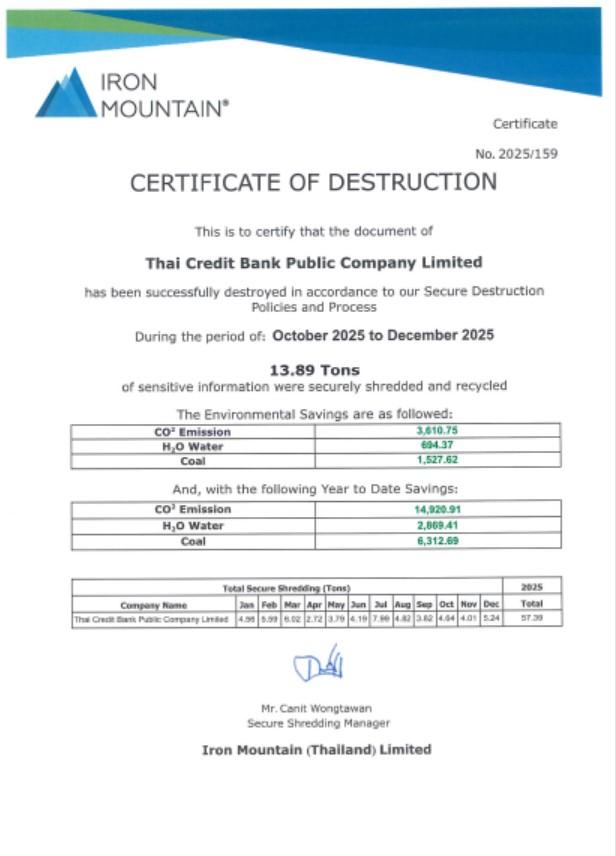
The Bank places importance on effective waste and waste management by operating in accordance with its environmental policy and continuously participating in the “Care the Whale” program in 2025 to promote the reduction of environmental impacts. The Bank communicated and raised awareness among employees through various channels, such as email, to encourage proper waste segregation and environmentally responsible destruction of documents that had reached the end of their retention period, with Certificates of Destruction obtained to confirm that destruction and recycling were conducted in accordance with established standards and policies. In 2025, the Bank properly destroyed 57.39 tons of documents, resulting in a reduction of approximately 14,920.91 kg CO2e of carbon dioxide emissions, and donated 2,983.99 kilograms of plastic bottles collected from employees for recycling into T-shirts for employees participating in environmental activities
.
Waste — Plan & Guidelines
Has a Waste Management Plan
Yes
Plan Description
The Bank has established a waste management plan aligned with the nature of its business operations as follows:
Continuous communication and awareness-raising through email and Microsoft Teams to promote waste segregation, reduce plastic usage, and reduce paper consumption.
Campaigns to reduce paper usage by encouraging the use of digital systems in place of printing, such as e-documents.
Collection and recording of data on various types of waste in order to improve waste management plans and practices to enhance overall efficiency.
Waste — Generation, Disposal & Recycling
Waste Generation, Disposal & Recycling
| Metric | Current Year | Previous Year | Two Years Ago |
|---|---|---|---|
| Total waste generated (Kilograms) | 60,373.99 | 14,875.73 | 95,694 |
| Non-hazardous waste (Kilograms) | 60,373.99 | 14,875.73 | 95,694 |
| Non-hazardous waste - Landfilling (Kilograms) | |||
| Non-hazardous waste - Incineration (with energy recovery) (Kilograms) | |||
| Non-hazardous waste - Incineration (without energy recovery) (Kilograms) | |||
| Non-hazardous waste - Other disposal operations (Kilograms) | |||
| Hazardous waste (Kilograms) | |||
| Hazardous waste - Landfilling (Kilograms) | |||
| Hazardous waste - Incineration (with energy recovery) (Kilograms) | |||
| Hazardous waste - Incineration (without energy recovery) (Kilograms) | |||
| Hazardous waste - Other disposal operations (Kilograms) | |||
| Total reused/recycled waste (Kilograms) | 2,983.99 | 3,103.5 | 1,453.37 |
| Reused/Recycled non-hazardous waste (Kilograms) | 2,983.99 | 3,103.5 | 1,453.37 |
| Reused non-hazardous waste (Kilograms) | 0 | 0 | 0 |
| Recycled non-hazardous waste (Kilograms) | 2,983.99 | 3,103.5 | 1,453.37 |
| Reused/Recycled hazardous waste (Kilograms) | |||
| Reused hazardous waste (Kilograms) | |||
| Recycled hazardous waste (Kilograms) |
Waste — Targets
Has Set Targets
Yes
Targets
| Waste Type | Disposal Approach | Target | Base Year | Base Year Value | Target Year | Target Year Value | Target Change (%) | Unit |
|---|---|---|---|---|---|---|---|---|
| Non-hazardous waste | 2759 · Description: Recycle | Reduce waste volume | 2,024 | 7,064.19 | 2,030 | 4,944.93 | 30 | Kilograms |
Waste — Performance & Outcomes
Has Performance Results
Yes
Performance Description
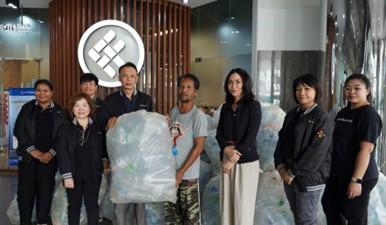
The Bank has continuously implemented measures to reduce plastic waste through the “Plastic Bottle Donation for Recycling” project, an initiative that encourages employee participation in reducing daily waste and supports resource recovery in line with the Circular Economy principle.
In 2025, the Bank collected and donated a total of 2,983.99 kilograms of plastic bottles from employees for recycling into T-shirts, helping to reduce landfill waste, decrease the use of new raw materials, and increase the volume of recycled materials reintroduced into the production chain, reflecting the Bank’s commitment to reducing environmental impacts and promoting waste segregation behaviors as well as the efficient use of resources within the organization.
Greenhouse Gas — Overview
Introduction
The Bank recognizes the importance of reducing greenhouse gas emissions from its business operations and has systematically collected and disclosed greenhouse gas emission data. The Bank has obtained ISO 14064-1 certification from BSI Group and Corporate Carbon Footprint certification from the Thailand Greenhouse Gas Management Organization (TGO) to verify the accuracy of greenhouse gas emission data from its activities, with the objective of supporting effective greenhouse gas management in line with sustainability principles.
The Bank has set greenhouse gas emission reduction targets in accordance with the framework of the Bank of Thailand (BOT), aiming to reduce Scope 1 and Scope 2 emissions from office operations by no less than 30 percent by 2030. In addition, the Bank has set targets to achieve carbon neutrality by 2050 and net zero greenhouse gas emissions by 2065, to support the mitigation of environmental and climate change impacts in a sustainable manner.
GHG — Plan & Guidelines
Has a GHG Management Plan
Yes
Plan Description
The Bank has established an action plan to reduce greenhouse gas emissions in alignment with its business operations, with a focus on the following areas:
Communication and Awareness Raising
The Bank communicates with employees to raise awareness of the importance of reducing greenhouse gas emissions through online channels such as email and internal communication platforms, in order to encourage participation and promote appropriate energy-use behaviors.Energy Consumption Reduction
The Bank sets short-term, annual targets to reduce energy consumption in office operations, including electricity and fuel, to support the achievement of greenhouse gas emission reduction targets under the established framework.Data Collection, Verification, and Disclosure
The Bank collects and verifies greenhouse gas emission data from its headquarters and branches nationwide in accordance with the GHG Protocol, ensuring accurate and transparent measurement and disclosure to support ongoing performance evaluation and continuous improvement.Compliance with ESMS Principles
The Bank conducts customer screening and refrains from engaging in business with customers associated with high risks, such as environmental risks, biodiversity impacts, and human rights risks.Green Loans
The Bank supports customers whose business operations take environmental considerations into account through dedicated financial products, including the “SME Kla-Plien” program.
GHG — Emissions
GHG Emissions
| Metric | Current Year | Previous Year | Two Years Ago | Remark |
|---|---|---|---|---|
| Total GHG emissions (Metric tonnes of carbon dioxide equivalent) | 3,680 | 3,151 | 5,722.73 | |
| Total greenhouse gas emissions 1 (Metric tonnes of carbon dioxide equivalent) | 589 | 505 | 1,478.7 | |
| Total greenhouse gas emissions 2 (Metric tonnes of carbon dioxide equivalent) | 2,537 | 2,646 | 3,917.7 | |
| Total greenhouse gas emissions 3 (Metric tonnes of carbon dioxide equivalent) | 554 | 326.33 | In 2025, the Bank calculated and assessed the materiality of greenhouse gas emissions under Scope 3 in accordance with the criteria prescribed by the Thailand Greenhouse Gas Management Organization (TGO). The Bank set the materiality threshold at a score of 2.5. The assessment results indicated that Scope 3 greenhouse gas emissions did not meet the reporting threshold; therefore, no disclosure was made for this section. |
GHG — Emissions Verification
Introduction
In 2025, the Bank enhanced its approach to the collection and disclosure of greenhouse gas emissions data, with a particular focus on expanding coverage of Scope 3 emissions in alignment with the expectations of the Bank of Thailand (BOT), in order to strengthen transparency and reporting standards. In addition, the Bank increased internal communication and coordination with relevant units to support accurate and comprehensive data collection, thereby facilitating effective assessment and future disclosure in accordance with international standards.
Emissions Verified by a Third Party
Yes
Verifying Body
3180
GHG — Principles & Standards
Introduction
The Bank is committed to integrating environmental and climate change considerations into its business strategy, risk management framework, and financial product development, in alignment with the supervisory guidelines of the Bank of Thailand (BOT). The Bank applies the principle of proportional risk management, tailored to its size, complexity, and level of environmental risk, while supporting national targets on carbon neutrality.
Integrating climate-related risks into governance, business strategy, and decision-making processes
Supporting Thailand’s targets to achieve carbon neutrality by 2050 and net zero greenhouse gas emissions by 2065
Promoting environmental finance to support customers’ transition to a low-carbon economy
Effectively managing climate-related risks in line with international sustainability standards, such as TCFD, UNPRB, and the principles of the Basel Committee
In 2025, the Bank established a governance structure and appointed a dedicated working team to oversee and drive climate change initiatives. This working team is responsible for defining relevant policies and strategies, monitoring performance in alignment with the Bank’s sustainability objectives and national directions, and managing climate-related risks and opportunities to ensure effective, transparent, and auditable operations.
Principles & Standards Applied
| Standard |
|---|
| 2671 |
| 2672 |
| 2676 |
GHG — Targets
Has Set GHG Targets
Yes
GHG Targets — Net Zero
Introduction
The Bank is committed to achieving Net Zero Greenhouse Gas Emissions by 2065. This long-term target covers all greenhouse gas emissions across Scopes 1, 2, and 3, including financed emissions. The Bank will implement rigorous measures to reduce greenhouse gas emissions in a tangible manner throughout its value chain and to support the long-term sustainable development of society.
Net Zero Targets
| Emission Scope | Base Year | Base Year Emissions | Near-term Target Year | Near-term Target Value | Near-term Target Change (%) | Long-term Target Year | Long-term Target Value | Long-term Target Change (%) | Target Year | Target Year Emissions | Target Change (%) | Unit |
|---|---|---|---|---|---|---|---|---|---|---|---|---|
| 2716 | 2,024 | 3,151 | 2,030 | 2,205 | 30 | 2,065 | 315 | 90 | 2,030 | 2,205 | 30 | Metric tonnes of carbon dioxide equivalent |
GHG Targets — Carbon Neutrality
Introduction
The Bank supports Thailand’s medium-term target of achieving Carbon Neutrality by 2050. The Bank is committed to reducing and offsetting carbon dioxide emissions from its operations to achieve net-zero emissions. This effort represents an important initial step in demonstrating environmental responsibility and strengthening financial resilience against transition risks.
Carbon Neutrality Targets
| Emission Scope | Carbon Neutrality Certified | Base Year | Base Year Emissions | Target Year | Target Year Emissions | Target Change (%) | Unit |
|---|---|---|---|---|---|---|---|
| 2715 | N | 2,024 | 3,151 | 2,050 | 1,575 | 50 | Metric tonnes of carbon dioxide equivalent |
GHG — Performance & Outcomes
Has Performance Results
Yes
Performance Description
The Bank is committed to managing and controlling greenhouse gas (GHG) emissions through the continuous implementation of action plans to mitigate climate impacts, with data collection conducted in accordance with international standards. In 2025, total GHG emissions increased by 18.46 percent compared with the previous year, attributable to the additional calculation and disclosure of Scope 3 emissions in line with the GHG Protocol. This expansion of the reporting boundary reflects the Bank’s commitment to more transparent and comprehensive data disclosure, enabling more effective management and strategic planning for GHG emission reductions across the value chain.
Environmental Legal Incidents
Legal Violation Incidents
| Metric | Current Year | Previous Year | Two Years Ago |
|---|---|---|---|
| Number of cases or incidents of legal violations or negative environmental impact (cases) | 0 | 0 | 0 |
Employees — Plan & Guidelines
Introduction
The Bank places great importance on human resource management and development, recognizing that employees are the most valuable asset in driving the organization's stable and sustainable growth. The Bank is committed to fair labor management, respecting human dignity, and implementing labor policies in accordance with international human rights principles, including the Universal Declaration of Human Rights ( UDHR), the United Nations Guiding Principles on Business and Human Rights (UNGPs), and the principles of the International Labour Organization (ILO).
Accordingly, the Bank develops its personnel management system in all dimensions, from recruitment, protection of labor rights, potential development, and quality of life care, to fostering an organizational culture that is equitable, transparent, and safe, enabling employees to grow with the organization in the long term.
Has an Employee Management Plan
Yes
Plan Description
Employee and Labor Management Plan
Fair Employment & Equal Opportunity
The Bank conducts transparent recruitment and employment processes, without discrimination based on gender, age, race, religion, disability, or any other status, while promoting Gender Equality and providing equal opportunities for all employees to access management positions. In addition, the Bank also supports the employment of vulnerable labor groups, such as persons with disabilities and underprivileged groups, to create sustainable social opportunities.
Treatment of Labor in accordance with Human Rights Principles (Human Rights & Labor Practices)
The Bank adheres to the principles of no forced labor, no child labor, no violation of employee rights, and zero tolerance for any form of discrimination or sexual harassment (Zero Tolerance Policy).
The Bank has a fair remuneration policy, with no gender pay gap, and strictly manages labor in accordance with labor protection laws and business ethics.
Compensation, Benefits, and Job Security (Compensation, Benefits & Welfare)
The Bank provides various forms of welfare benefits that align with the needs of its employees, such as:
Fair salaries and bonuses
Health and insurance benefits
Statutory leave and holidays
Work arrangements that support Work-Life Balance, such as WFH and Flexible Working.
The Remuneration and Nomination Committee will consider a remuneration structure that is appropriate, transparent, and fairly reflects the value of work performed by employees and executives.
Occupational Health, Safety, and Quality of Work Life (Occupational Health & Safety)
The Bank has established a Safety, Occupational Health, and Working Environment Committee to oversee safety and reduce potential risks to employees' lives, bodies, and health. Furthermore, it promotes health measures such as reducing the risk of infectious diseases, hygiene measures, and continuous activities to enhance employees' mental and physical well-being.
Capability Development and Career Progression (Learning, Capability & Career Development)
The Bank consistently aims to develop employees' skills and potential through training programs, on-the-job learning, and preparation for management positions, enabling employees to grow professionally according to their abilities. Furthermore, the Bank communicates and conveys organizational values, ethics, and work standards to all employees comprehensively.
Grievance Mechanisms, Rights Protection, and Remedy (Grievance Mechanisms & Remedy)
The Bank provides secure and confidential grievance channels through the Whistleblower system and other internal channels, allowing employees to report incidents related to discrimination, harassment, or human rights issues. Upon receiving a report, the Bank will investigate and inform the results within 30 days, along with implementing appropriate remedial measures, to ensure that employees are protected according to their proper rights.
Integration of ESG and Human Rights in Work Processes (ESG Integration & HRDD)
The Bank applies the Human Rights Due Diligence (HRDD) process to assess human rights risks across its operations involving employees, customers, business partners, and communities. The assessment results will be used to improve processes, prevent, and mitigate potential impacts, as well as linked to employee performance indicators and rewards, to incentivize the most effective compliance.
Communication, Transparency, and Reporting (Transparency & Reporting)
The Bank discloses information on labor, human rights, welfare, safety, and social performance to the Board of Directors at least once a year, and also reports to the public in accordance with the ESG operational framework, to ensure investors and stakeholders are informed of the progress and transparency in the Bank's human resource management.
Plan Areas
| Plan Area | Other — Please Specify |
|---|---|
| Fair employee compensation | |
| Employee training and development | |
| Promoting employee relations and participation | |
| Occupational health and safety in workplace | |
| Others | Non-discrimination |
Employees — Workforce
Workforce Data
| Metric | Current Year | Previous Year | Two Years Ago |
|---|---|---|---|
| Total number of employees (Persons) | 4,542 | 4,342 | 3,990 |
| Number of male employees (Persons) | 1,997 | 1,952 | 1,767 |
| Number of female employees (Persons) | 2,545 | 2,390 | 2,223 |
| Total employment of disabled persons (people) | 44 | 39 | 26 |
| Total disabled employees (people) | |||
| Total male disabled employees (people) | |||
| Total female disabled employees (people) | |||
| Total disabled workers who are non-employee (people) | |||
| Contributions to the fund for promoting and improving the quality of life for disabled persons | 1 | 1 | 1 |
| Total number of male employees in operational level (Persons) | 1,985 | 1,941 | 1,756 |
| Total number of male employees in management level (Persons) | 3 | 2 | 2 |
| Total number of male employees in executive level (Persons) | 9 | 9 | 9 |
| Total number of female employees in operational level (Persons) | 2,534 | 2,378 | 2,212 |
| Total number of female employees in management level (Persons) | 9 | 10 | 9 |
| Total number of female employees in executive level (Persons) | 2 | 2 | 2 |
Employees — Remuneration & Provident Fund
Remuneration & Provident Fund
| Metric | Current Year | Previous Year | Two Years Ago |
|---|---|---|---|
| Total disabled employees (people) | 3,864,213,158.8 | 3,633,032,766.48 | 3,112,891,980.15 |
| Total male employee remuneration (Baht) | 1,915,088,636.48 | 1,841,066,830.12 | 1,559,881,666.05 |
| Total female employee remuneration (Baht) | 1,949,124,522.32 | 1,791,965,936.36 | 1,553,010,314.1 |
| Number of employees eligible to participate in PVD (persons) | 4,135 | 4,041 | 3,595 |
| Total number of employees joining employee provident fund (Persons) | 3,383 | 3,311 | 2,938 |
| Percentage of total number of employees joining employee provident fund to total number of employees (%) | 74.48 | 76.26 | 73.63 |
| Number of PVD members / Total eligible employees (%) | 81.81 | 81.94 | 81.72 |
| Total amount of provident fund contributed by the Company (Baht) | 143,266,493 | 127,197,696 | 111,543,487 |
| Total amount of provident fund contributed by employee (baht) | 148,782,384 | 126,302,181 | 106,302,181 |
Employees — Training & Development
Training Data
| Metric | Current Year | Previous Year | Two Years Ago |
|---|---|---|---|
| Average employee training hours (Hours / Person / Year) | 17.7 | 4.39 | 8.11 |
| Employee development and training expenses (baht) | 5,770,000 | 6,050,000 | 5,680,000 |
Employees — Occupational Health & Safety
Occupational Health & Safety Data
| Metric | Current Year | Previous Year | Two Years Ago |
|---|---|---|---|
| Total number of lost time injury incidents by employees (Cases) | 2 | 0 | 0 |
Employees — Labour Relations
Labour Relations Data
| Metric | Current Year | Previous Year | Two Years Ago |
|---|---|---|---|
| Total voluntary resignations (Persons) | 1,014 | 1,158 | 996 |
| Male employees who voluntary resigned (Persons) | 464 | 497 | 435 |
| Female employees who voluntary resigned (Persons) | 550 | 661 | 561 |
| Percentage of employee turnover leaving the Company voluntarily (%) | 22.32 | 26.67 | 25 |
| Evaluation result of employee engagement | 1 | 1 | 1 |
Employees — Employee Representation
Introduction
The bank organized elections for the Welfare Committee with a term of office 2 years, to discuss and provide beneficial recommendations to the employer for employees. The Committee held meetings to review welfare benefits and various factors that the bank wished to consider for employees. In 2024, the bank's management decided to provide financial assistance of 1,000 Baht per month to employees earning less than 15,000 Baht and financial assistance of 500 Baht per month to employees earning less than 20,000 Baht to help with employees' monthly expenses.
In the year In 2025, the Committee approved additional employee welfare benefits and adjusted criteria for existing benefits to be more inclusive of human rights, including:
Increased birthday leave entitlement, where employees can take leave on any day within their birth month only.
Expanded the scope of personal leave entitlement to allow leave for matters related to children's education at educational institutions recognized by the Ministry of Education.
Expanded the scope of welfare benefits for marriage leave and wedding financial support to include equal marriage, in order to respond to and support human rights and gender diversity within the bank.
Employees Are Represented Collectively
Yes
Forms of Representation
| Form |
|---|
| Welfare committee |
Employees — Targets
Has Set Employee Targets
Yes
Targets
| Indicator | Target Areas | Base Year | Base Year — Description | Target Year | Target Year — Description |
|---|---|---|---|---|---|
| AML/CTPF Review (Biennial) | 2984 · Description: Employee training and development | 2,025 | AML/CTPF Review (Biennial) | 2,027 | 100% of employees at all levels have completed the aforementioned training course. |
| Employees possess knowledge of IT Security Awareness | 2984 · Description: Employee training and development | 2,025 | 100% of employees have completed training in the aforementioned course. | 2,026 | 100% of employees at all levels have completed the aforementioned training course. |
| Employees have knowledge and understanding of Phishing E-Mail Awareness. | 2984 · Description: Employee training and development | 2,025 | 100% of employees at all levels have completed the aforementioned training course. | 2,026 | 100% of employees at all levels have completed the aforementioned training course. |
| Employees attend Anti-Corruption training | 2984 · Description: Employee training and development | 2,025 | 98.1% of employees completed the aforementioned training course. | 2,030 | 100% of employees at all levels have completed the aforementioned training course. |
| Employees receive annual training to review PDPA. | 2984 · Description: Employee training and development | 2,025 | 100% of employees at all levels have completed the aforementioned training course. | 2,030 | 100% of employees at all levels have completed the aforementioned training course. |
| Employee engagement or satisfaction assessment results from the Employee Survey | 2985 · Description: Promoting employee relations and participation | 2,024 | Employee engagement or satisfaction assessment results for the organization: 81.2 percent. | 2,030 | Employee engagement or satisfaction with the organization is assessed at no less than 85%. |
| Number of employee work-related injuries resulting in lost time (incidents) | 2988 · Description: Safety and occupational health at work | 2,025 | Number of work-related injuries among employees leading to lost time: 2 cases. | 2,030 | Zero lost-time work injuries among employees. |
Employees — Performance & Outcomes
Introduction
The Bank recognizes the value and importance of human resources as a key factor in driving the bank's business to achieve its goals. Therefore, the Bank prioritizes effective and efficient human resource management and development to support personnel in continuous career growth and foster organizational commitment. This ensures the Bank can retain its personnel to work continuously, in compliance with labor protection laws and international practices, by respecting the rights, honor, dignity, and equality of all employees. This human resource management and development policy has been established to serve as a framework for the Bank's human resource management and development, aiming to enhance the Bank's operational efficiency towards its set goals.
Additionally, the Bank regularly organizes activities throughout 2025 to enhance employee engagement. These activities allow employees from each department to participate together during various festivals, such as New Year's and Songkran, to preserve good cultural traditions. Furthermore, there are channels for promoting organizational activities, such as internal communication through HR Speak Up!, an online marketplace for employees to sell products called Em Market, and communication channels via TVs on each floor called Em Watch.
The Bank has installed communication channels in a total of 156 branches in major cities, and in 2026, there are plans to further expand installations to secondary cities.
Has Performance Results
Yes
Performance Description
Performance and Outcomes in Employee and Labor Management
Employee Training
The bank prioritizes the growth of employees' potential through continuous training and skill development. In 2024-2025, 100% of employees completed training and demonstrated awareness of operating procedures in accordance with bank measures. They signed acknowledgments in the bank's operational manual and passed the employee ethics test with 100% completion, reflecting an organizational culture committed to developing employee potential while upholding ethics, transparency, and a balance between "efficiency" and "fairness" in human resource management.
Employee Data Management in accordance with PDPA Policy
- Improved the employee database storage system to be 100% compliant with PDPA requirements.
- PDPA training is regularly provided to cover all levels of employees, achieving 100% completion of the training target.
Communication
The bank also emphasizes transparent and comprehensive internal communication through various channels to foster mutual understanding and strengthen a robust organizational culture. In 2025, communication was conducted through the following channels:
HR Speak Up! – The total number of public relations items was 581 items with content related to employees from the Human Resources department, more than 40.5 %
Online marketplace for employee products, or Em Market
TV communication channels on each floor, or Em Watch. In 2025, a total of 156 screens were installed across the Bank’s branches, with continuous dissemination of promotional content throughout the year, amounting to more than 460 content in total.
HR Management Internal website, Throughout the year, the total number of views for content on the website was 138,300 views, representing 3,044.91% of the total number of employees or an average of approximately 30.45 views per person
Employee Relationship and Engagement Promotion
The bank recognizes the value and importance of all employees, not only new hires but also those who have been with the bank for a long time. In 2025, the bank organized the Long Service Award and DNA Award 2025 to honor 126 employees who have served for 10 and 20 years, and to present awards to 85 individuals who have demonstrated outstanding alignment with the bank's organizational DNA culture.
Customer Management — Overview
Introduction
The Bank is responsible and committed to being part of sustainably enhancing the quality of life for customers and society. It recognizes that many people still lack access to formal financial services, leading them to rely on informal loans. Therefore, the Bank is committed to developing diverse financial products and services, fostering financial literacy, and empowering society, especially the underserved groups who lack access to formal financial services. This includes developing financial channels to make financial services more accessible to customers, coupled with promoting good financial discipline, supporting good financial well-being, and improving quality of life. With expertise and understanding of customer needs, the Bank develops service processes to create access to financial products that cover all stakeholder groups through innovation, collaboration with business partners, and continuous improvement and development based on customer data analysis. It also regularly organizes seminars and educational activities for customers. Furthermore, the Bank creates convenient and accessible communication and financial literacy channels appropriate for all stakeholder groups.
The Bank believes that providing knowledge tailored to the needs of each customer and societal group will enable individuals to plan their finances in various aspects, such as debt management, appropriately for their acceptable risk level. This will prevent them from incurring debts beyond their repayment capacity, foster financial stability, and allow them to sustainably expand their businesses. This approach will also support the Bank's long-term sustainable business growth. The Bank has initiatives to promote financial literacy, such as the 'Tang To Know-How' project and the 'Empower for Community' project.
In addition, the Bank has a policy to develop employees' communication skills with customer groups or relevant stakeholders, ensuring that financial products are not oversold and that sales practices respect customers/consumers, in accordance with the Market Conduct policy for all the Bank's products.
Customers — Plan & Guidelines
Has a Customer Management Plan
Yes
Plan Description
Responsible Product and Service Delivery to Customers ( Responsible Product and Service Delivery)
The bank adheres to the principle of "Fair Treatment of Customers" ( Market Conduct) and "Responsible Lending," focusing on transparency, fairness, and consideration of customers' ability to repay debt.
Product Design: The bank develops highly flexible financial products and services to create financial opportunities (Access Financial Capitals) for target customer groups, especially those lacking opportunities.
Sustainable Loans: The bank has developed new products emphasizing social and environmental responsibility:
- SME Kla Plien (Green Loan): A loan supporting entrepreneurs who wish to invest in making their businesses environmentally friendly or who already operate environmentally friendly businesses.
- SME Kla Hai Lady First: An unsecured revolving loan designed to enhance the financial capabilities of female entrepreneurs.
- Participated in the "You Fight, We Help" Phase 2 measure to help debtors quickly settle debts through lenient debt restructuring and faster account closure. Customers were informed that they could register via the Bank of Thailand's website, www.bot.or.th/khunsoo, from February 13 to September 30, 2025.
Environmental and Social Risk Management ( ESMS): The bank has implemented the ESMS (Environmental and Social Management System) to screen and assess environmental and social risks (ESDD) for SME and MSME loans. A Prohibited List of 18 business groups that may have significant negative impacts on the environment and society has been established.
Employee Competence: The bank has organized courses E-Learning on the ESMS system for relevant employees (e.g., credit analysts, HR, MSME). In 2025, 100% of all participants (827 individuals) passed the course.
Communication of information regarding the impact of products and services to customers/consumers
The bank prioritizes providing accurate, clear, complete, and unbiased information to ensure customers have sufficient data for decision-making.
Data Transparency: The bank fully discloses important information about its products and services, including terms, risks, rates, service fees, and interest rates.
Responsible Communication: Advertising and public relations must communicate transparently with clear messages that do not mislead, and provide important information and warnings to stimulate debtor behavior ( to help customers achieve better financial discipline.
Communication Channels: Important information will be published on the bank's website. , annual reports, and other channels to ensure shareholders/investors receive equal information.
Enhancing Customer Satisfaction and Strengthening Customer Relationships
The bank adopts a proactive approach to building long-term relationships and enhancing customer potential, particularly in financial literacy.
Customer Relationship Management (CRM)
- Established a Customer Relationship Management Team ( CRM Team) and Call Center to continuously meet needs and provide excellent experiences.
- Utilizes digital platforms ( Mobile Application: alpha by Thai Credit and Micro Pay e-Wallet) to enable customers to conduct transactions and access financial services conveniently, anytime, anywhere.
- Thai Credit Bank hosted a gala night to thank customers Micro SME and SME Ready to STANDBY for Success Beyond the Horizon, to thank customers who have consistently trusted and utilized the bank's Micro SME and SME loan services. This event included a special lecture on "The Future Economy with Thai SMEs" by Assoc. Prof. Dr. Anusorn Tamajai, Dean of the Faculty of Economics and Director of the Digital Economy, Investment, and International Trade Research Center, University of the Thai Chamber of Commerce, held at River City Bangkok on November 15, 2025.
"Tang To Know-How" (Financial Literacy)
- This is a key project focused on providing financial literacy to micro-entrepreneurs, vendors, and various vulnerable groups.
- The objective is to foster financial discipline and economic resilience, enabling customers to manage debt and sustainably expand their businesses.
- In 2025, with a total of 63,763 participants. The Net Promoter Score (NPS) was 81%.
Complaint Management:
- Channels for customer complaints are available (e.g., Call Center, Email: complain_center@thaicreditbank.com, Website) to ensure fair and appropriate resolution of issues.
- The bank is committed to resolving issues and managing complaints with independence, efficiency, and fairness.
Protection of Customer Personal Data
The bank places great importance on protecting personal data and customer privacy.
Policies and Measures: The bank has established a Personal Data Protection Policy ( Personal Data Protection Policy) and Data Classification Policy, which apply to all personnel. Additionally, IT Security Policy measures are in place to protect personal data.
Sensitive Data Management: Customer personal data (including sensitive data such as health information, race) is considered "confidential data" ( or "Secret data," which must be strictly confidential and have restricted access.
Incident Management: There is a personal data breach incident management process, requiring notification of personal data breaches to the Personal Data Protection Committee within 72 hours of becoming aware of the incident. And in 2025, the bank identified one personal data breach incident involving lost document data. The bank has already reported this to the Personal Data Protection Committee (PDPC), and no cyber-attack cases were found.
Others (Additional Measures)
Customer Harassment Zero Tolerance Policy (Zero Tolerance Policy)
- The bank has established a policy to protect employees from customer harassment ( Employee Protection from Customer Harassment Policy) in 2025, based on the principle of "absolute zero tolerance for harassment from customers or third parties" (Zero Tolerance Policy).
- This policy protects employees from inappropriate behavior such as abusive language, threats, sexual or racial discrimination, or unwanted physical contact.
- Measures include immediate customer warnings, termination of conversations/interactions, suspension of services, and legal action in severe cases.
Access to digital financial services (Digital Access)
- The Bank has developed the Micro Pay e-Wallet (for merchants) and the alpha by Thai Credit mobile banking application to promote digital financial transactions and digital deposit account opening (alpha savings), which offers a high interest rate.
- As of the end of 2025, Micro Pay has over 604,085 user accounts, and alpha by Thai Credit has 44,260 user accounts.
Plan Areas
| Plan Area |
|---|
| Responsible production and services for customers |
| Communication of product and service impacts to customers/consumers |
| Development of customer satisfaction and customer relationship |
| Protection of customer personal information |
Customers — Satisfaction Results
Customer Satisfaction Results
| Metric | Current Year | Previous Year | Two Years Ago |
|---|---|---|---|
| Evaluation results of customer satisfaction | 1 | 1 | 1 |
Customers — Targets
Has Set Customer Targets
Yes
Targets
| Indicator | Target Areas | Base Year | Base Year — Description | Target Year | Target Year — Description |
|---|---|---|---|---|---|
| Customer Satisfaction Percentage (MFIN/MSME) | 3007 · Description: Responsible production and services for customers · 3009 · Description: Development of customer satisfaction and customer relationship | 2,024 | Customer satisfaction 96% | 2,030 | Customer satisfaction rate: 98% |
| Number of consumer rights complaints | 3007 · Description: Responsible production and services for customers · 3008 · Description: Communication of product and service impacts to customers/consumers · 3010 · Description: Consumer data privacy and protection · 3011 · Other name: Consumer Rights · Description: Other | 2,024 | Number of incidents of consumer rights complaints, Case Center | 2,030 | Number of incidents of consumer rights complaints, Case Center |
Customers — Performance & Outcomes
Has Performance Results
No
Community & Social — Plan & Guidelines
Introduction
The Bank has a policy for community and social development through its main project, "Tang To Know-How," which has been continuously implemented since 2017. Its objective is to promote financial knowledge and skills among micro-entrepreneurs, the general public, and youth, to build economic resilience for communities and society, develop the potential of micro-entrepreneurs to grow sustainably, and establish a network of cooperation for community and social development.
Furthermore, the Bank has also developed the plan "Thai Credit Creates a Sustainable Future: Empowering Community Development" to serve as a framework for systematic and comprehensive community and social development operations across all dimensions, and collaborates with Thai Credit Foundation to drive social projects and activities under the concept of " EMpower Education & Opportunities - Empowering Education, Creating Opportunities for the Future." All operations align with the United Nations Sustainable Development Goals (SDGs) across 6 areas.
Has a Community & Social Plan
Yes
Plan Description
1. Disadvantaged and vulnerable groups
Promoting access to funding sources and financial services
The Bank promotes inclusive and equitable access to funding and financial services, particularly for small entrepreneurs and vulnerable groups, through a range of credit products such as nano and microcredit for small businesses, micro SME loans, and loans for OTOP entrepreneurs.
Expanding target groups
Expands target groups to be more comprehensive, especially disadvantaged groups, vulnerable groups, low-income individuals, and people in remote communities, to provide opportunities for everyone to access necessary funding sources and financial knowledge.
2. Reducing social inequality
Tang To Know-how
Organize training activities to provide financial knowledge on money management, financial planning, debt management, and business development for all segments of the public, including students, university students, civil servants, salaried employees, and entrepreneurs. These activities are provided free of charge through both offline channels at Thai Credit Bank’s retail lending branches nationwide and online channels via digital platforms, to ensure broad and inclusive access to financial knowledge.
Develops curricula in collaboration with the Faculty of Accountancy, University of the Thai Chamber of Commerce, to create quality learning content that meets the needs of all target groups.
Integrated Community Development Plan
Economic aspect : Organizes "Tang To Know-how" training, supporting the upgrading of community products, developing local packaging, and creating marketing channels.
Social aspect : Develops future skills, enhances the potential of new-generation community leaders, and develops community welfare systems.
Environmental aspect : Develops waste and residual material management systems, promotes clean energy, and develops low-carbon products.
Thai Credit Foundation Project
Educational Institution Donation Project ( EMpower for School Development): Aims to reduce educational inequality by directly donating funds to schools to improve learning environments and provide learning equipment according to the context of each area.
Youth Scholarship Program ( EMpower for Children): Provides scholarships to youth who are eager to learn but lack financial resources, to offer opportunities for access to quality education, reduce economic barriers, and promote educational equality.
Empowering Society Project ( EMpower for Society): Supports specialized charitable organizations through monetary donations to expand social development on a broad scale.
Partnership Network
Sign a Memorandum of Understanding (MoU) with the Community Development Department, Ministry of Interior, to jointly enhance the capacity of personnel, community leaders, and network organizations by strengthening their knowledge and skills in systematic financial management and debt management.
3. Employment and Occupational Skills Development
Support for Career Development and Income Generation
Supports career development, income generation, and the strengthening of the grassroots economy by collaborating with public and private sector agencies to organize training sessions aimed at developing business skills and financial management in businesses, enabling entrepreneurs to enhance the efficiency of their products and services, thereby ensuring stable and sustainable business operations.
Supports occupational equipment for communities to increase productivity and income for community members.
Supports distribution channels for community products.
Creating professional speakers
Focuses on creating qualified internal trainers who can professionally impart knowledge through " Train the Trainer" and "Professional Speaker" courses.
Develops financial knowledge and skills for youth leaders through the project "Tang To Know-How Young Ambassador" to enable youth to effectively transfer financial knowledge to their classmates and community members.
4. Others include promoting financial literacy.
Tang To Know-how
Continuously implemented since 2017, focusing on instilling financial discipline and business skills to enhance the quality of life for the public and strengthen the grassroots economy.
Continuously develop and update financial literacy curricula to ensure relevance to current contexts, covering topics such as expense management, financial goal planning, savings, and business management, with content tailored to specific target groups
Multiple Access Channels
Conduct training sessions in offline formats at the Bank’s branches nationwide across 76 provinces, as well as through outreach training in various local areas.
Provide online training through digital channels to enhance accessibility and convenience for target groups.
Continuously expand the number of participants through both offline and digital platforms.
Evaluation and monitoring
Has a systematic evaluation and monitoring system to continuously develop and improve projects.
Regularly monitors and evaluates projects to enhance the efficiency of action plans.
Plan Document Link
https://www.thaicreditbank.com/th/%E0%B8%81%E0%B8%B2%E0%B8%A3%E0%B8%9E%E0%B8%B1%E0%B8%92%E0%B8%99%E0%B8%B2%E0%B8%98%E0%B8%B8%E0%B8%A3%E0%B8%81%E0%B8%B4%E0%B8%88%E0%B9%84%E0%B8%A1%E0%B9%82%E0%B8%84%E0%B8%A3
Plan Areas
| Plan Area | Other — Please Specify |
|---|---|
| Employment and professional skill development | |
| Disadvantaged and vulnerable groups | |
| Reducing inequality and promoting social equality | |
| Others | Financial literacy promotion |
Community & Social — Targets
Introduction
The bank has established clear and measurable community and social management goals, linked to the United Nations Sustainable Development Goals ( SDGs) across 6 areas: No Poverty (SDG 1), Quality Education (SDG 4), Decent Work and Economic Growth (SDG 8), Industry, Innovation, and Infrastructure (SDG 9), Reduced Inequalities (SDG 10), and Climate Action (SDG 13).
The Bank communicates its action plans to employees at all levels, fostering participation and shared commitment among all parties, and reports quantitative and qualitative results for transparent stakeholder scrutiny.
Has Set Community & Social Targets
Yes
Targets
| Indicator | Target Areas | Base Year | Base Year — Description | Target Year | Target Year — Description |
|---|---|---|---|---|---|
| Number of participants in the Tang To Know-how program | 3045 · Other name: Financial literacy promotion · Description: Others | 2,025 | Participants: 308,782 persons | 2,027 | Target participants: 450,000 persons |
| Satisfaction and Referral Scores | 3045 · Other name: Financial literacy promotion · Description: Others | 2,025 | Achieved 80 percent satisfaction score | 2,027 | Not less than 80% (Excellent level) |
| Number of users accessing business tools | 3045 · Other name: Financial literacy promotion · Description: Others | 2,025 | Number of people who accessed business support tools: 2,518 | 2,027 | Number of users accessing business support tools: 25,000 |
| Number of followers on social media channels | 3045 · Other name: Financial literacy promotion · Description: Others | 2,025 | Number of followers on social media channels: 381,995 | 2,027 | 460,000 followers on social media channels |
| Number of Employee Volunteers | 3045 · Other name: Social Contribution Activities · Description: Others | 2,025 | Number of volunteer employees: 1,364 | 2,027 | Number of employee volunteers: 1,500 persons |
| Number of communities engaged with the bank | 3044 · Description: Reducing inequality | 2,025 | Three communities participating with the bank. | 2,027 | 4 communities involved with the bank |
Community & Social — Performance & Outcomes
Introduction
The Bank has demonstrated outstanding performance in community and social development, particularly through the 'Tung To Know-how' project, which has been continuously implemented for 9 years (2017-2025). This initiative has created widespread positive impacts on micro-entrepreneurs, the general public, and youth, and has received recognition from both government and private sector organizations for its efforts in promoting financial literacy and sustainable community development.
Has Performance Results
Yes
Performance Description
Project Performance Results: “Tang To Know-how” Project
Quantitative Outcomes:
Total number of participants trained over a 9-year period: 308,782 people, from 7,566 activities, covering 76 provinces nationwide.
Number of participants trained in 2025: 68,444 people.
Satisfaction and recommendation (word-of-mouth) rate in 2025: 80%.
89% of entrepreneurs demonstrate good debt repayment behavior.
73% of participants record their income and expenses.
65% of participants have savings behavior.
97% of participants apply the knowledge gained from the training in practice.
Total number of followers across social media platforms (Facebook, YouTube, and TikTok): 381,995 followers.
Qualitative Outcomes:
The Bank has received numerous awards and recognitions from various organizations, reflecting its strong commitment to corporate social responsibility (CSR), particularly in promoting financial literacy and fostering sustainable community development. The Bank’s excellence and dedication to CSR initiatives have been consistently acknowledged through prestigious awards from both public and private sector organizations. In 2025, the Bank received several significant awards that demonstrate its achievements and tangible social impact.
Honorary Award for the Financial Discipline Promotion Campaign
This award is presented by the Federation of Thai Business and Professional Women’s Associations under the Royal Patronage, in collaboration with the Ministry of Social Development and Human Security, the Stock Exchange of Thailand, the Thai Chamber of Commerce, the Thai Bankers’ Association, and the Council of Child and Youth Development Organizations under the Royal Patronage of Her Royal Highness Princess Maha Chakri Sirindhorn.
The award recognizes the Bank’s success in promoting financial discipline among the public, which serves as a fundamental pillar of economic stability. Thai Credit Bank has received this prestigious award for two consecutive years.
Creativity Awards
In 2025, the Bank received the “Creativity Awards” for submitting the “Tang To Know-how” project to the competition organized by the Securities and Exchange Commission, Thailand (SEC). This award is presented to organizations that demonstrate outstanding creativity in communicating financial literacy, making financial knowledge accessible, memorable, appropriate, easy to understand, and comprehensible to the general public.
The Financial Changemaker Award
The Bank received “The Financial Changemaker Award” from the Securities and Exchange Commission, Thailand (SEC) in its capacity as a Finfluencer under the project “Thai Capital Market: Empowering Financial Knowledge for the Public – Phase 2 (2025)”.This award is presented to organizations that demonstrate excellence in effectively communicating financial and investment knowledge to the public and in creating tangible impact. The Bank delivered high-quality, easy-to-understand, and practical content through social media platforms (Facebook, YouTube, and TikTok) under the name “Tang To Know-how by Thai Credit Bank.” In 2025, the content achieved over 1,000,000 reach/views, and covered seven core competency areas in alignment with international standards set by the OECD.
Leading of ESG – Social Product” Award
In 2025, the Bank received the “Leading of ESG – Social Product” Award at the Future Trends Award 2025, a prestigious platform that recognizes organizations with outstanding initiatives and innovations in Environmental, Social, and Governance (ESG). This award is presented to banks that demonstrate excellence in social management practices, in alignment with assessment standards, and that are capable of delivering tangible, measurable social outcomes and impact.
Collaboration with Strategic Partners
The Bank signed a Memorandum of Understanding (MoU) with the Department of Community Development, Ministry of Interior, to jointly drive financial literacy promotion initiatives. This collaboration reflects the Bank’s credibility and the trust placed in it by government agencies, while reinforcing its capacity to create shared value for communities.
The Bank integrated cooperation with a broad network of partners from both the public and private sectors, to scale up community and social development initiatives in a comprehensive and sustainable manner.
Community Development Project Performance
The Bank has continuously implemented community development projects for the third consecutive year, with a focus on strengthening two target community groups. The initiatives emphasize knowledge enhancement, capacity building, and the provision of appropriate resources, aiming to foster long-term sustainability and resilience within the communities.
Performance of Community Development Projects
The Bank has continuously implemented community development projects for the third year, focusing on strengthening two target community groups through knowledge promotion, capacity building, and appropriate resource support to create long-term sustainability for the communities.
Group 1: Ban Suksabai Community, Don Tum District, Nakhon Pathom Province
The Bank supported the development of the community-based soil and fertilizer management center, elevating it to become the “Ban Suksabai Community Learning Center, Village No. 14.” The Center serves as a knowledge-sharing hub for organic agriculture and sustainable resource management for community members and the general public.
Key Performance Results for 2025
Knowledge Transfer
The Learning Center organized knowledge transfer activities in various areas, including organic fertilizer production, plant cutting techniques, and Azolla cultivation. In 2025, a total of 402 visitors received knowledge transfer from the Learning Center, reflecting its crucial role as a learning resource for the community and surrounding areas. It generated income for the community from visitation fees and learning activities totaling 39,525.07 Baht per year.
Capacity Building in Waste Management
The Bank organized a study visit activity to enhance the community's knowledge of waste management. A delegation visited the Ban Rang Plub Community Learning Center in Ratchaburi Province to exchange experiences and apply excellent waste management practices in the community.
Support for Tools and Equipment
The bank supported the community with one multi-purpose shredder to enhance the efficiency and production capacity of organic fertilizer. This enabled the community to produce a larger quantity of fertilizer and adequately meet its needs.
Community Product Promotion
In addition to agricultural and environmental development, the Bank has also promoted and developed products for the Ruam Thai Suk Sabai Community Enterprise Group by providing consultation on product quality improvement, packaging design, and distribution channels. This has resulted in increased income from product sales for the community enterprise group.
Group 2: Ban Mankong Pracha Samakkee Community, Bang Phlat District, and Bor Farang Rim Nam Community, Chatuchak District
The Bank expanded its community development initiatives into urban areas, selecting Ban Mankong Prachasamakkee Community in Bang Phlat District and Bor Farang Riverside Community in Chatuchak District as target communities for capacity building and community empowerment.
Financial Literacy
Recognizing the importance of effective financial management in improving quality of life, the Bank organized financial literacy activities for members of both communities. The programs covered key topics including personal and household financial planning, effective income and expense management, saving, investment, and financial security planning, as well as responsible and safe use of financial services, and debt prevention and resolution.
Thai Credit Foundation Performance
Thai Credit Foundation, established on September 30, 2022, operated through 3 main projects:
School Donation Project (EMpower for School Development): Provided financial support to schools to improve learning environments and procure educational equipment, benefiting a total of 10 schools.
Scholarship Program for Youth (EMpower for Children): Provided opportunities for underprivileged youth to access quality education, with a total of 100 children receiving scholarships.
Empower for Society Project (EMpower for Society): Supported a total of 15 charitable organizations in expanding social development efforts.
Performance of other social activities
Other social activities in 2025 included:
- Financial mentoring activities
- Providing lunch for infants at foundations supporting children in urban slum communities
- Painting fabric bags and dolls for children with disabilities (Art For All)
- Providing lunch for children with disabilities at the Foundation for the Welfare of the Disabled under the Royal Patronage, Nonthaburi
- Donation drives for cloth and paper bags for patient medication packaging
- Children’s Day gift donation activities
- Donation of calendars for the production of Braille books
- Participation in developing learning materials for schools
- A total of 40,194 people benefited from financial literacy activities, school development, community development, and other activities.
- A total of 1,364 Thai Credit Bank volunteer employees participated in good deeds to help society, representing 29% of all employees.
- The number of volunteer hours by Thai Credit Bank employees in 2025 was 12,270 hours.
A total of 40,194 individuals benefited from financial literacy activities, school development initiatives, community development programs, and other social activities.
A total of 1,364 Thai Credit Bank employee volunteers participated in social contribution activities, representing 29% of the Bank’s total workforce.
The total number of volunteer service hours contributed by Thai Credit Bank employees in 2025 amounted to 12,270 hours.
Other Social Management
Introduction
In addition to the Tang To Know-how and the operations of Thai Credit Foundation, Thai Credit Bank Public Company Limited, have also developed a framework “Thai Credit Creates Sustainable Future: Empowering Community Development” (Creating Sustainable Future: Empowering Community Development) to serve as a guideline for systematic and comprehensive in-depth community development operations across all dimensions.
This project is a collaboration among the private sector, government organizations, and the public, with Thai Credit Bank serving as the primary driving force in conjunction with its network partners. It focuses on integrated community development that considers economic, social, and environmental dimensions to sustainably strengthen communities from within, in line with the principles of sustainable banking ( Sustainable Banking), the principles of circular economy (Circular Economy), and the United Nations Sustainable Development Goals (SDGs).
Plan & Outcomes — Introduction
The Bank has an integrated community development plan through the project "Building a Sustainable Future: Empowering Community Development," with a plan to develop communities over a 3-year period through integrated cooperation from various network partners, both public and private sectors, to create a prototype model that can be sustainably expanded to other communities, implemented through 5 main steps: target community selection, community study and analysis, project planning and design in collaboration with the community, integration of cooperation from network partners, and 3-dimensional integrated community development (economic, social, and environmental), with a pilot project in Ban Mankong Prachasamakkhi Community, Bang Phlat District, Bangkok.
Plan & Outcomes — Description
Integrated Community Development Plan
1. Community selection and development process
Target Community Selection
Utilize analytical data from reliable sources, including basic needs data (Jor Por Tor) and data TPMAP (Thailand Poverty Map and Area-Based Targeting)
Define selection criteria in 4 Dimensions: (1) Potential for community economic development (2) Strength of leaders and level of participation (3) Actual problems and needs (4) Alignment with local and national development strategies
Community Study and Analysis
Organize community forums to listen to community needs
Collect basic economic, social, and environmental data
Analyze SWOT with community leaders and representatives
Project Planning and Design
Develop a long-term development plan 3 years, divided into 4 phases: (1) Analysis and Design (2) Capacity Building (3) Implementation and Monitoring (4) Lesson Learning and Expansion
Define clear and measurable objectives, goals, and success indicators
Establish cooperation agreements ( MOU) with the community
2. Integration of Network Partner Collaboration
Primary Stakeholders:
Thai Credit Bank - Key agency in project management, providing financial support and knowledge transfer, organizing training in finance and business management
Department of Community Development, Ministry of Interior - Support community development processes and link government policies
Community Organizations Development Institute (Public Organization) - Provide management consulting and develop community organization potential
Business partners - Support product enhancement and marketing channels
Supporting Stakeholders:
Local administrative organizations
Educational institutions
Non-governmental organizations ( NGO)
3. Integrated Community Development in 3 Dimensions
Dimension 1: Economic Development
Establish central kitchens/community production centers with hygiene standards
Elevate product quality and standards to meet FDA standards GMP or community product standards
Develop packaging and create unique community product brands
Develop digital marketing skills and create diverse distribution channels
Connect with business partners to enter national value chains
Dimension 2: Social Development
Develop future skills such as digital skills, creative thinking skills
Organize financial and accounting management training for community entrepreneurs
Strengthen the potential of new generation community leaders
Create a system for knowledge and skill transfer between generations
Develop community welfare systems
Support social activities such as educational support, elderly care
Dimension 3: Environmental Sustainability
Develop waste and residual material management systems based on circular economy principles (Circular Economy)
Develop sustainable packaging, focusing on recyclable materials and reducing single-use plastics
Develop handicraft products from recycled materials with commercial value
Promote clean energy and develop low-carbon products
Raise environmental awareness through campaigns and various activities
4. Activities and Operational Plan
Year 1 (2026): Year of Foundation Building
Establishment of Community Central Kitchens
Product and packaging development
Entrepreneurial Capacity Building
Environmental development and Circular Economy
Year 2 (2027): Year of Expansion
Marketing Channel Development
Product Standard Enhancement
Networking
Activities CSR for the Community
Year 3 (2028): Year of Sustainability
Succession and Expansion
Evaluation and Improvement
5. Success Indicators
Output Indicators
Number of people who received financial knowledge
Number of products developed
Number of people who received entrepreneurial knowledge
Number of people who received waste management knowledge
Satisfaction with various activities
Outcome Indicators
Trainees have improved financial behavior
Community members' income increased
Trainees apply knowledge to develop and expand their careers
Reduced amount of food waste in the community
Impact Indicators
Community members possess knowledge of financial management, business operations, and waste management, leading to career creation, income generation, and ultimately strengthening the community. This results in an improved quality of life for community members and the establishment of model communities.
This project is implemented in conjunction with the Tang To project Know-how and operations of Thai Credit Foundation to create widespread impact on community and social development in Thailand, ranging from financial literacy to integrated in-depth community development (creating a sustainable future), which aligns with the bank's philosophy "Everyone Matters".
Law Violation Incidents
Law Violation Incidents
| Metric | Current Year | Previous Year | Two Years Ago | Remark |
|---|---|---|---|---|
| The total number of cases or incidents of significant violations of laws or regulations regarding social and human rights (Cases) | 1 | 1 | 0 | |
| The total number of cases or incidents that cause significant labor disputes (Cases) | 0 | 0 | 0 | |
| The total number of cases or complaints related to consumer rights violations (Cases) | 0 | 0 | 0 | |
| The total number of cases or complaints related to partner rights violations (Cases) | 0 | 0 | 0 | |
| The total number of cases or incidents that cause disputes with the community/society (Cases) | 0 | 0 | 0 | |
| The total number of cases or incidents related to cyber security or customer data breaches (Cases) | 1 | 1 | 0 | These reported cases or incidents are related to customer personal data breaches, as reported by the bank to the Office of the Personal Data Protection Committee. However, these incidents are not related to cybersecurity. |
| The total number of cases or incidents related to safety and occupational health at work (Cases) | 0 | 0 | 0 |
Law Violations — Case Detail & Corrective Measures
Incidents & Corrective Measures
| Year | Incident Detail | Status | Remediation Measures | Non-financial Impact | Financial Impact Incurred (THB) | Financial Impact Expected (THB) |
|---|---|---|---|---|---|---|
| 2,025 | The bank has identified a personal data breach involving lost document data. The bank has already reported this incident to the Personal Data Protection Committee Office (PDPC). | Incident no longer subject to action | The Bank has implemented additional personal data security measures in documented form, and has also emphasized and communicated to its personnel to raise awareness regarding personal data breaches. | Currently, there is no impact from the event. | 0 | 0 |