

Business Operation · 2025
In this section23 topics
- Corporate Information4 items
- Dividend Policy2 items
- Major Shareholders3 items
- Business Strategies Overview6 items
- Material Changes & Developments1 item
- Use of Proceeds from Securities Offerings2 items
- Commitments Made in the Registration Statement1 item
- Group Operating-Structure Policy1 item
- Companies Where the Company Holds ≥10%1 item
- Shareholders with Potential Conflict of Interest1 item
- Relationships Among Major Shareholders1 item
- Shareholders' Agreement1 item
- Shareholding Diagram (Group Structure)2 items
- Income Structure3 items
- Product / Service Characteristics2 items
- Research & Development2 items
- Assets Used in the Business4 items
- Marketing Policy & Competition3 items
- Procurement of Products & Services2 items
- Product Information — Overview1 item
- Projects Under Construction1 item
- Debentures & Bills of Exchange2 items
- Convertible Securities1 item
Corporate Information
Company Name
THAI CREDIT BANK PUBLIC COMPANY LIMITED
Telephone
026975300
Website
www.thaicreditbank.com
ir@thaicreditbank.com
Dividend Policy
Dividend Policy
The Bank has a dividend payment policy that complies with notifications of the Bank of Thailand and applicable laws. In this regard, the Board of Directors determines dividend payments by considering the Bank’s capacity to pay dividends based on net profit as presented in the separate financial statements after deduction of corporate income tax and all types of statutory and other reserves as required by law and as determined by the Bank for each year. Such dividend payments shall not exceed the retained earnings shown in the Bank’s separate financial statements. In the event that the Bank has accumulated losses, the Bank shall not consider any dividend payment. In this regard, the Board of Directors shall assess the Bank’s dividend-paying capacity in accordance with legal requirements and the Bank’s Articles of Association, exercising prudence and taking into account various factors primarily for the benefit of shareholders, including economic conditions, operating performance and financial position, cash flows, investment plans and business expansion, provisions for debt repayment, compliance with covenants under contractual agreements, working capital requirements, potential risks that may arise in the future, as well as any other necessity or appropriateness as deemed relevant by the Board of Directors.
Dividend payments must not materially affect the Bank’s normal operations and shall be subject to applicable laws, rules, regulations, or relevant rulings. Once the Board of Directors has approved the Bank’s annual dividend payment, such payment shall be proposed for approval at the shareholders’ meeting, except for interim dividends, which the Board of Directors is authorized to approve from time to time when it deems that the Bank has sufficient profits to justify such payment. Any interim dividend payment shall be reported to the shareholders at the next shareholders’ meeting.
At the Bank’s Board of Directors’ Meeting No. 2/2023, held on 22 February 2023, the Board approved in principle the dividend payout ratio framework for the period from 2024 to 2027, which is expected to be in the range of approximately 5 percent to 20 percent of net profit for each respective year. Prior to approving any dividend payment on each occasion, the Bank shall comply with applicable laws and ensure that such payment is made in accordance with the dividend policy as set forth above.
Historical Dividend Payments
| This Year | Last Year | 2 Years Ago | Metric | Description | Remark |
|---|---|---|---|---|---|
| 2.95 | 0 | 0 | Net profit per share (Baht : Share) | Net profit per share (baht : share) | |
| 0.6 | 0 | 0 | Dividend per share (Baht : Share) | Dividend per share (baht : share) | |
| 0 | 0 | 0 | Dividend stock ratio (Number of original shares: dividend shares) | Ratio of stock dividend payment (existing share : stock dividend) | |
| 0 | 0 | 0 | Dividend share value per share (Baht : Share) | Value of stock dividend per share (baht : share) | |
| 0.6 | 0 | 0 | Total dividend payment value (Baht : Share) | Total dividend payment (baht : share) |
The Bank was listed on the Stock Exchange on 8 February 2024. Accordingly, the Bank began considering dividend payments to its shareholders in 2025.
|
| 20.3 | 0 | 0 | Dividend payout ratio to net profit (%) | Dividend payout ratio compared to net profit (%) |
Business Strategies Overview
Introduction
The Bank’s Board of Directors places strong emphasis on the continuous review of the organization’s strategy, vision, mission, purpose, and core values. Such reviews are conducted in close consultation with the Management Committee to ensure alignment with the Bank’s business direction and long-term strategic objectives. In this regard, the Board also plays a key role in overseeing management’s operations to ensure execution in accordance with the established strategy, while closely monitoring performance to ensure that the organization achieves its goals effectively and sustainably.
In the past year, at the Board of Directors’ Meeting No. 12/2025, held on December 20, 2025, the Board reviewed the Bank’s vision, mission, organizational purpose, and core principles to ensure alignment with the Bank’s business objectives and strategic direction.
Chairman's Message
The cooperation of employees at all levels, management, and the Board of Directors throughout 2025 served as a key driving force behind Thai Credit Bank’s growth into a full-fledged commercial bank. During the year, the Bank successfully listed its shares on the Stock Exchange of Thailand and delivered satisfactory operating results, supported by prudent and sustainable business expansion.
In the years ahead, challenges will intensify not only for Thai Credit Bank but across all sectors of the economy and for people both domestically and globally; however, I am confident that Thai Credit Bank’s organizational strength derived from a multigenerational workforce, diverse ways of thinking and working, openness to listening and learning from one another, and strong morale under the enduring philosophy of “Everyone Matters” will enable the Bank to adapt to business challenges, technological changes, and evolving customer behaviors, and to move forward together toward organizational success, customer satisfaction, and value creation for all stakeholders.
An indispensable element of the Bank’s operations is its steadfast commitment to conducting business in accordance with sustainability principles that encompass responsibility across three dimensions environmental stewardship (Environment), social responsibility (Social), and good corporate governance (Governance), or ESG under which, in 2025, Thai Credit Bank received an “Excellent” rating in the Corporate Governance Reporting (CGR) assessment under the Thai Listed Companies Corporate Governance Survey conducted by the Thai Institute of Directors Association, while concurrently advancing aligned initiatives such as greenhouse gas management, the development of financial products aimed at reducing inequality, the promotion of financial literacy through the “Tang To” program, community strengthening, the expansion of access to formal financial resources, and the enhancement of transparency and good corporate governance among management and the Board of Directors; accordingly, ESG is no longer merely a business option but a matter of long-term survival, and Thai Credit Bank takes pride in being one of the driving forces contributing to happiness, well-being, income stability, and the achievement of success for stakeholders across all dimensions of its operations.
Vision
Thai Credit Bank is committed to supporting its customers’ business growth and enhancing their quality of life through the Bank’s distinctive microfinance services.
Objectives
To provide the best financial services to small-scale entrepreneurs nationwide.
To promote financial literacy and financial discipline among all customers.
To foster an organizational culture in which all employees are motivated and take pride in their collective achievements.
To create sustainable value for shareholders while taking into account the interests of all stakeholders.
Goals
“Everyone Matters” has been a guiding philosophy of the Bank for more than a decade and serves as the foundation of its strategy, objectives, and approach to conducting business. The Bank has developed a business model that focuses on serving small-scale entrepreneurs who are often overlooked, viewing them as business owners rather than merely borrowers. Accordingly, the Bank’s lending practices are built on relationship-based principles and a genuine culture of customer care, which reflect the Bank’s core values and organizational culture.
Business Strategies
Thai Credit Bank is a bank that has demonstrated continuous growth and has been recognized as one of the fastest-growing banks over the past several decades. Although 2025 was a challenging year for Thailand’s economy and the financial industry, the Bank was still able to continue its growth and achieve a growth rate higher than that of other financial institutions in the industry.
The Bank’s core strategy continues to focus on three main areas: growth of its core loan portfolio, the development of information technology (digital transformation), and new business development. The Bank has consistently demonstrated its ability to achieve rapid growth within the industry for more than a decade, while continuing to emphasize the provision of sustainable financial services to micro customers and underserved customer segments with limited access to the formal financial system. In addition, the Bank places strong importance on credit quality management to ensure solid growth in both the short and long term. The Bank emphasizes a customer-centric approach and the delivery of real value, including the development and design of highly flexible products that can respond to diverse customer needs. The Bank is committed to building strong customer relationships through understanding and engagement, in order to support the continued growth of customers’ businesses.
The Bank continues to move forward with its digital transformation strategy to strengthen its capabilities and enhance competitiveness. In the past year, the Bank implemented its Digital Transformation 1.0 plan, which focused on laying the foundation for technology infrastructure, improving core systems, enhancing customer experience across digital channels, and increasing overall operational efficiency.
For the coming year, the Bank will progress to Digital Transformation 2.0, with a focus on the design and development of a comprehensive digital banking platform to fully support digital financial services. This plan will emphasize the development of a modern system architecture that supports connectivity with new technologies, as well as the use of data analytics to develop products and services that better meet customer needs, while enhancing security and user experience to create differentiation and sustainability in the digital era.
Providing fair treatment to customers is a critical operational process to protect customers and ensure the sustainability of the Bank’s business. The Bank adheres to the Bank of Thailand’s principles on fair treatment of customers and is committed to operating with transparency, responsible lending practices, and fairness. This includes clear disclosure of information, fair pricing, and appropriate advice, to ensure that customers receive complete information and are treated with honesty and integrity.
The Bank is committed to driving community development, particularly through the “Tang To Know-How” program, a financial literacy initiative that targets not only small-scale entrepreneurs but also students and salaried employees. The program aims to enable participants to learn about saving, wealth creation, and financial management through practical and easy-to-understand approaches. The program is well recognized and trusted, and since its establishment in 2017, more than 308,782 people have participated. In 2025, the program had more than 68,444 participants and achieved a Net Promoter Score (NPS) of over 80 percent, reflecting a very high level of participant satisfaction, as the program’s content can be directly applied to everyday life.
Material Changes & Developments
Material Changes & Developments
| Year | Description |
|---|---|
| 1,970 | The Bank was founded as Thai Keha Credit Foncier Company Limited to engage in the financial service business |
| 2,005 | The Bank was registered as a public limited company named Thai Keha Credit Foncier Public Company Limited on July 28, 2005 with a registered capital of Baht 300.0 million and increased its registered capital to Baht 1,000.0 million. |
| 2,025 |
|
| 2,024 |
|
| 2,023 |
|
| 2,022 |
|
| 2,021 | The Bank increased its registered capital from Baht 5,156.25 million to Baht 5,903.75 million to accommodate the aforementioned warrants. |
| 2,019 |
|
| 2,018 | Established Thai Micro Digital Solutions Co., Ltd. ("TMDS"), a subsidiary of the Bank with 99.99% of the total paid-up capital, to provide electronic financial transaction services through the application "Micro Pay" (Micro Pay e-Wallet). |
| 2,017 | The Bank increased its registered capital from Baht 4,125.0 million to Baht 5,156.25 million. |
| 2,016 | The Tang To Know-how project was initiated to promote financial literacy and to inculcate knowledge in financial planning, savings, debt management, and financial risk management in times of crisis for the micro enterprises and SMEs as well as members of the general public that are salaried individuals. A good financial knowledge will help participants make better financial management decisions in the future and increase their ability to live a stable life and their self-esteem. |
| 2,015 |
|
| 2,014 | The Bank increased its registered capital from Baht 3,000.0 million to Baht 3,125.0 million. |
| 2,013 | The Bank began to operate lending branches, which are branches that only provide loan services and are in a community area near the establishment of micro enterprises and SMEs. This branch model differs from that of the general bank branches to inclusively serve demand for formal loans among retail business clients. |
| 2,012 | The Bank has changed the structure of its management team, whereby Mr. Winyou Chaiyawan became the Chief Executive Officer and Mr. Roy Agustinus Gunara ("Mr. Roy") became the Managing Director to support growth in The future is headed towards “The Best Retail Commercial Bank” |
| 2,010 | The Bank increased its registered capital from Baht 1,500.0 million to Baht 2,000.0 million in April, 2010 and to Baht 3,000.0 million in October 2010. |
| 2,008 | The Bank increased its registered capital from Baht 1,000.0 million to Baht 1,500.0 million. |
| 2,007 |
|
| 2,006 | The Bank was licensed to operate a commercial bank on December 22, 2006 to operate a commercial bank business for retail businesses. |
Use of Proceeds from Securities Offerings
Introduction
In reference to the Initial Public Offering (IPO) of Thai Credit Bank Public Company Limited (“Bank”) during 23 – 26 January 2024 in the amount of 64,705,890 shares at the price of THB 29 per share and the listing of the Company’s shares on the Stock Exchange of Thailand on 9 February 2024. The Bank has received the IPO proceeds of THB 1,834.9 million, (after deduction of the expenses related to the IPO). The Bank would like to report on the utilization of capital increasing from IPO as of 31 December 2025 as follows:
(Unit : THB million) | ||||
Objectives of Use of Proceeds | Approximate Amount | Outstanding proceeds as of 30 June 2025 | Accumulated Use of Proceeds from July 1 to December 31, 2025 | Remaining Amount as of 31 December 2025 |
Strengthen the Bank's capital for the purpose of expanding loan portfolio. | 917.4 | 0 | 0 | 0 |
Improving and developing information technology systems in relation to digital transformation and IT security infrastructure | 917.4 | 610.1 | 116.7 | 493.4 |
Total | 1,834.9 | 610.1 | 116.7 | 493.4 |
Is There Money Raised from a Securities Offering Still to Report On?
No
Commitments Made in the Registration Statement
Are There Commitments or Conditions from an Offering or Listing?
No
Group Operating-Structure Policy
Description
The Bank holds a direct shareholding in one subsidiary, in accordance with the definition prescribed by the Securities and Exchange Commission (SEC). As of December 31, 2025, the details are as follows:
Thai Micro Digital Solutions Co., Ltd. (“TMDS”)
Established on April 4, 2018
Provides payment services under the supervision of the Bank of Thailand.
As of December 31, 2025, its registered capital is 450,000,000 baht.
Office address: 121/108 RS Tower, 41st Floor, Ratchadaphisek Road, Din Daeng Subdistrict, Din Daeng District, Bangkok 10400.
Companies Where the Company Holds ≥10%
Companies (≥10% Holding)
| Company Name | Address | Province | Zip Code | Telephone | Business Type | Security Type | Shares | Paid-up Shares |
|---|---|---|---|---|---|---|---|---|
| Thai Micro Digital Solutions Co., Ltd | No. 121/108, RS Tower, 41st Floor, Ratchadaphisek Road, Din Daeng Sub-district, Din Daeng District | Bangkok | 10400 | 02-697-5353 | Payment Processing Activities for Financial Transaction | Common shares | 44,999,985 | 44,999,985 |
Income Structure
Product / Service Income
| Category | Description | This Year | This Year % | Last Year | Last Year % | 2 Years Ago | 2 Years Ago % |
|---|---|---|---|---|---|---|---|
| Total revenue from operations | Total revenue from operations | 18,163,134 | 100 | 18,137,962 | 100 | 15,894,566 | 100 |
| Interbank and money market items | 277,587 | 1.53 | 396,565 | 2.19 | 340,494 | 2.14 | |
| Investments in debt instruments | 48,502 | 0.27 | 104,078 | 0.57 | 62,581 | 0.39 | |
| Loans to customers | 17,671,836 | 97.3 | 17,505,568 | 96.51 | 15,371,339 | 96.71 | |
| Hire-purchase | 160,443 | 0.88 | 130,145 | 0.72 | 119,837 | 0.75 | |
| Other | Other | 4,766 | 0.03 | 1,606 | 0.01 | 315 | 0 |
Export Income
| Category | Description | This Year | This Year % | Last Year | Last Year % | 2 Years Ago | 2 Years Ago % |
|---|---|---|---|---|---|---|---|
| Total revenue | Total revenue from operations | 18,163,134 | 100 | 18,137,962 | 100 | 15,894,566 | 100 |
| Domestic | Domestic | 18,163,134 | 100 | 18,137,962 | 100 | 15,894,566 | 100 |
| International | International | 0 | 0 | 0 | 0 | 0 | 0 |
Other Income
| Operating Other Income | Non-Operating Other Income | Share of Profit |
|---|---|---|
| 1710 · As of year: 1006542.0 · Description: Total other income · As of yesteryear: 561656.0 · As of year before yesteryear: 704140.0 · 1711 · As of year: 982236.0 · Description: Other income from operations · As of yesteryear: 563454.0 · As of year before yesteryear: 709740.0 | 1712 · As of year: 24306.0 · Description: Other income not from operations · As of yesteryear: -1798.0 · As of year before yesteryear: -5600.0 | 1713 · As of year: 0.0 · Description: Share of profit · As of yesteryear: 0.0 · As of year before yesteryear: 0.0 |
Product / Service Characteristics
Business Type
3115
Business Groups
| Business Group | Description | |||||||||||||||||||||||||||||||||||||||||||||||||||||||||||||||||||||||||||||||||||||||||||||||||||||||||||||||||||||||||||||||||||||||||||||||||||||||||||||||||||||||||||||||||||||||||||||||||||||||||||||||||||||||||||||||||||||||||||||||||||||||||||||||||||||||||||||||||
|---|---|---|---|---|---|---|---|---|---|---|---|---|---|---|---|---|---|---|---|---|---|---|---|---|---|---|---|---|---|---|---|---|---|---|---|---|---|---|---|---|---|---|---|---|---|---|---|---|---|---|---|---|---|---|---|---|---|---|---|---|---|---|---|---|---|---|---|---|---|---|---|---|---|---|---|---|---|---|---|---|---|---|---|---|---|---|---|---|---|---|---|---|---|---|---|---|---|---|---|---|---|---|---|---|---|---|---|---|---|---|---|---|---|---|---|---|---|---|---|---|---|---|---|---|---|---|---|---|---|---|---|---|---|---|---|---|---|---|---|---|---|---|---|---|---|---|---|---|---|---|---|---|---|---|---|---|---|---|---|---|---|---|---|---|---|---|---|---|---|---|---|---|---|---|---|---|---|---|---|---|---|---|---|---|---|---|---|---|---|---|---|---|---|---|---|---|---|---|---|---|---|---|---|---|---|---|---|---|---|---|---|---|---|---|---|---|---|---|---|---|---|---|---|---|---|---|---|---|---|---|---|---|---|---|---|---|---|---|---|---|---|---|---|---|---|---|---|---|---|---|---|---|---|---|---|---|---|---|---|---|---|---|---|---|---|---|---|---|---|---|---|---|---|---|
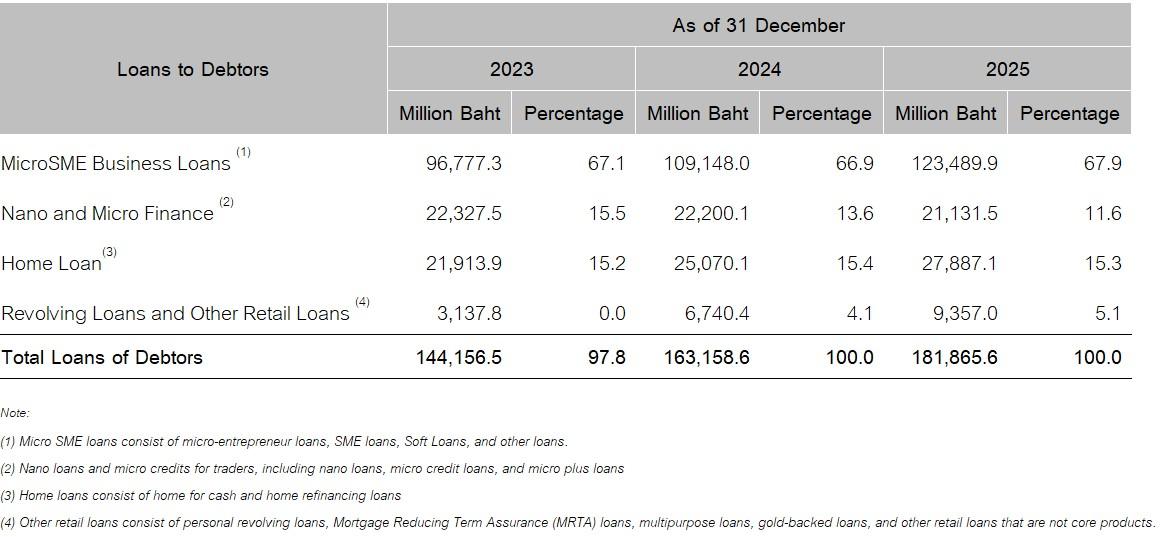
| 1. Lending Business | The table below presents details of the Bank’s loan product portfolio as of 31 December 2023, 2024, and 2025.
Micro SME loans are the Bank’s core product, representing the highest proportion of total loans extended to customers, providing financial support for working capital and funding to enhance business liquidity, support business expansion, or refinance business loans from other financial institutions; popular products and services include “SME Kla-Plien,” designed for customers with strong operating performance and good financial history, and the Bank offers a diverse range of more than 10 sub-loan products to accommodate the varying needs and limitations of each entrepreneur, including both secured and unsecured loan products, covering individual and juristic person customers. Micro SME loans primarily consist of (a) SME loans with collateral and the approved limit does not exceed the value of collateral; (b) secured loans with approved credit limits exceeding the collateral value; (c) unsecured loans; (d) overdraft facilities; and (e) “SME Kla-Plien” loans, with details of the Micro SME loan products as follows:
The Bank recognizes the importance and necessity of developing loan products and services that effectively address the needs of micro-entrepreneurs, particularly merchants, enabling them to access formal financing without the requirement for collateral, together with a streamlined approval process to ensure timely access to funding. This initiative aims to support micro-entrepreneurs, who form the foundation of Thailand’s economy, in overcoming crises and restoring their businesses through a diverse range of tailored loan products. Nano and Micro credit comprise the following core products: (a) Nano Credit; (b) Micro Credit; and (c) Micro Plus and Micro Max, with details as follows:
The Bank commenced its Home for Cash loan product in 2015 with the intention of assisting customers in reducing their debt burden by consolidating multiple loans into a single facility, in response to the large number of individuals holding personal and other loans across several facilities at relatively high interest rates; under this program, customers use their land and house or condominium unit as collateral to consolidate such debts, enabling longer repayment tenors that reduce monthly installment obligations in line with repayment capacity, while benefiting from interest rates lower than those of personal loans, thereby enhancing liquidity and promoting financial discipline through a single structured repayment plan with one financial institution; the Bank also offers home refinance products for customers with existing housing loans from other financial institutions, with an option for additional top-up multipurpose facilities, and currently does not provide new home purchase loans; Home for Cash products comprise the following core categories: (a) Home for Cash; (b) Refinance home loan; and (c) Refinance Plus, the details of which are set out below:
Personal loans are revolving credit facilities under the supervision of the Bank of Thailand, granted without collateral or guarantors and subject to a reducing balance interest rate. The products primarily target customers with regular income, such as salaried employees, state enterprise employees, and government officials. Borrowers may choose a revolving credit facility or refinance credit card debt and other personal loans, with a maximum approved credit limit of THB 2 million. Borrowers earning THB 30,000 or more per month are eligible for a credit limit of up to five times their average monthly income, while those earning less than THB 30,000 per month are eligible for a credit limit of up to 1.5 times their average monthly income (subject to other conditions as determined by the Bank). Such credit limits are in accordance with the regulatory criteria prescribed by the Bank of Thailand. Customers may opt to make minimum payments, full repayments, or installment payments of up to 60 installments, enabling effective financial planning. The Bank charges interest at a rate not exceeding 25 percent per annum, which represents the maximum interest rate and fees permitted by the Bank of Thailand. In addition, the Bank has entered into a receivables purchase agreement with Ascend Nano in respect of receivables arising under loan agreements entered into between Ascend Nano and its borrowers (the “Loan Receivables”). The Bank will purchase only those Loan Receivables that meet its selection criteria as specified in the agreement. Such arrangement supports the Bank’s strategy to expand its revolving personal loan products to new target segments beyond customers with regular income. In this regard, after the transfer of the Loan Receivables from Ascend Nano has been completed, the Bank shall be entitled to the outstanding principal, accrued interest, and related fees under such loan agreements, and the borrowers shall make repayments through the True Money Wallet application and/or through other agreed channels.
The Bank also offers other retail loans such as loans with gold as collateral, hire-purchase loans for individual customers and other retail loans Distribution ChannelsIn providing lending services, the Bank reaches its target customers through Relationship Managers and Credit Advisors. The Bank provides training to such personnel in both fundamental knowledge and product-specific techniques to ensure that they are able to accurately and comprehensively communicate financial knowledge and product details to customers. In addition, the Bank has established an organizational structure with appropriate checks and balances by supervisors, including Team Managers, Zone Managers, and Regional Managers, who are responsible for communicating the Bank’s policies and strategies, as well as monitoring overall performance and loan quality to ensure alignment with common objectives. The Bank has appointed Credit Advisors to support nano finance and micro credit for small business customers. Their responsibilities include product presentation, credit analysis (prior to submission to the Team Manager, Zone Manager, and Regional Manager for approval in accordance with the relevant approval authority), and loan repayment collection. To enhance staff efficiency and reduce reliance on manual processes, Credit Advisors utilize the Tels-nano system to assist in credit quality analysis and recommend appropriate credit limits, as well as tablets to improve processing time and minimize human error. Furthermore, the Bank operates a branch network located within communities across all regions, covering 74 provinces in Thailand, to ensure customer accessibility and facilitate access to formal lending services. The Bank’s lending branches are categorized into two formats: (1) lending branches, which serve as primary branches located in major cities, and (2) nano credit offices (kiosks), which function as sub-branches of lending branches and are located in or near marketplaces. As of 31 December 2025, the Bank operated 500 lending branches. Most lending branches also provide micro SME loans and nano and micro credit for small traders, as loan agreements must be executed at the Bank’s branches in accordance with applicable regulations. With respect to housing loans and retail loans, which primarily target individual customers, distribution is conducted through Relationship Managers under the Retail and Wealth Business Group via the Bank’s branch network. In addition, the Bank engages independent direct sales agents (Direct Sales Agents) to provide advisory services and offer home equity loan products, thereby enhancing its ability to access new customers beyond those reached through its deposit branches. | |||||||||||||||||||||||||||||||||||||||||||||||||||||||||||||||||||||||||||||||||||||||||||||||||||||||||||||||||||||||||||||||||||||||||||||||||||||||||||||||||||||||||||||||||||||||||||||||||||||||||||||||||||||||||||||||||||||||||||||||||||||||||||||||||||||||||||||||||
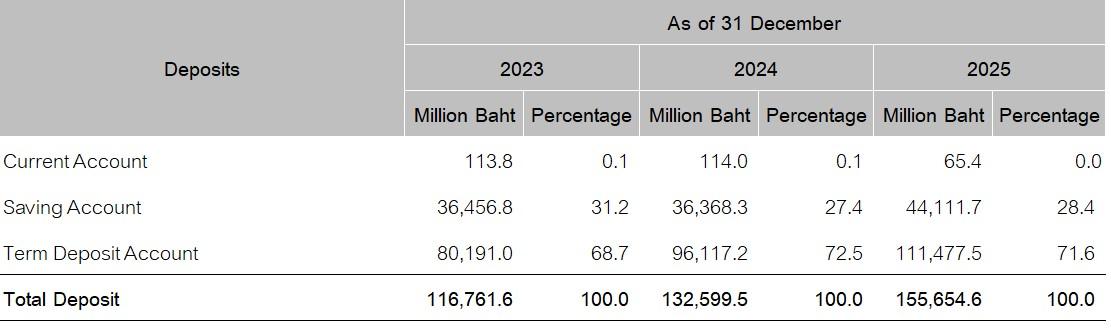
| 2. Deposit Business | The table below shows details of the Bank’s loan product portfolio as of 31 December 2023, 2024, and 2025.
(a) Current Account A deposit account for entrepreneurs or business operators seeking greater flexibility in withdrawals via cheque issuance, with the ability to monitor transactions through monthly account statements.
(b) Saving Account A deposit account designed to provide flexibility in deposits and withdrawals for all customer segments, including individuals and juristic persons, enabling access to basic banking services for savings or spending purposes as required.
(c) Fixed Deposit Account In order to promote savings and long-term financial planning for its customers, the bank offers higher interest rates for various term deposit products which specify clear and exact deposit terms and withdrawal timeframes.
Distribution Channels As of 31 December 2025, the Bank operated 33 deposit service branches, the majority of which are located in Bangkok and its metropolitan area, targeting individual and wealth customers with high-value and long-term savings needs, resulting in a high level of deposits per branch. In addition, deposit services are also available through the alpha by Thai Credit application, which enhances customer convenience and enables broader and more efficient access to customers. | |||||||||||||||||||||||||||||||||||||||||||||||||||||||||||||||||||||||||||||||||||||||||||||||||||||||||||||||||||||||||||||||||||||||||||||||||||||||||||||||||||||||||||||||||||||||||||||||||||||||||||||||||||||||||||||||||||||||||||||||||||||||||||||||||||||||||||||||||
| 3. Insurance brokerage business. | The bank has a strategy of acting as an insurance agent for various companies in order to select products to offer that meet the needs of loan and individual customers. This is a non-exclusive product distribution model. As of December 31, 2025, the bank is an insurance broker for six companies: (1) Thai Life Insurance Public Company Limited, (2) Thaipaiboon Insurance Public Company Limited, (3) Thai Health Insurance Public Company Limited, (4) Prudential Life Assurance (Thailand) Public Company Limited, (5) Muang Thai Life Assurance Public Company Limited, and (6) Ocean Life Insurance Public Company Limited. This covers savings life insurance, annuity life insurance, accident insurance, fire insurance, and credit life insurance. The insurance products are offered through bank employees who hold insurance broker licenses for non-life and/or life insurance. | |||||||||||||||||||||||||||||||||||||||||||||||||||||||||||||||||||||||||||||||||||||||||||||||||||||||||||||||||||||||||||||||||||||||||||||||||||||||||||||||||||||||||||||||||||||||||||||||||||||||||||||||||||||||||||||||||||||||||||||||||||||||||||||||||||||||||||||||||
| 4. Investment Units of Mutual Funds | With a commitment to offering investment in mutual fund units as an alternative to enhance investment returns or obtain tax benefits, as well as to serve as a channel for wealth management through portfolio allocation for retirement planning, financial planning, and/or effective risk diversification, the Bank acts as a selling agent for mutual fund units of six asset management companies, namely (1) ONE Asset Management Co., Ltd., (2) MFC Asset Management Public Company Limited, (3) Krungsri Asset Management Co., Ltd., (4) Krung Thai Asset Management Public Company Limited, (5) Aberdeen Asset Management (Thailand) Limited, and (6) SCB Asset Management Co., Ltd.. Such products are distributed through the Bank’s deposit service branches. | |||||||||||||||||||||||||||||||||||||||||||||||||||||||||||||||||||||||||||||||||||||||||||||||||||||||||||||||||||||||||||||||||||||||||||||||||||||||||||||||||||||||||||||||||||||||||||||||||||||||||||||||||||||||||||||||||||||||||||||||||||||||||||||||||||||||||||||||||
Research & Development
Has R&D Policy (Y/N)
No
R&D Cost — Label
Research and development (R&D) expenses over the past 3 years (Million Baht)
Assets Used in the Business
Permanent Assets — Description
The Bank’s head office is located in Bangkok. As at 31 December 2025, the Bank operated 500 retail lending branches and 33 deposit branches. The principal fixed assets used in the operations of the Bank and its subsidiaries comprise: (1) property and equipment, including buildings, leasehold improvements, office equipment, computers and related equipment, and right-of-use assets; (2) assets held for sale, consisting of properties acquired through debt settlement; (3) intangible assets, including software and initial service fees for ITMX (Interbank Transaction Management and Exchange); and (4) Other assets.
Details and information relating to the assets used in the Bank’s operations are presented in Appendix 4 (Assets Used in Business Operations).
Intangible Assets — Description
As of 31 December 2025, the Bank’s intangible assets presented in the consolidated financial statements under intangible assets consist of computer software, the ITMX initial membership fee, and computer software under installation, with a total net book value of Baht 303.9 million.
Has Subsidiaries Investment Policy (Y/N)
Yes
Subsidiaries Investment Policy — Description
The bank has an investment policy focused on companies that support its business operations and align with the group's goals, vision, and strategic plans for growth. These investments aim to increase the bank's performance or profits, or to create synergy with the bank, thereby enhancing its competitiveness and enabling it to achieve its goal of becoming a leading player in its core business. The bank, its subsidiaries, and/or associated companies may consider investing in additional businesses if they have growth potential, can be leveraged for business expansion, or benefit the group's operations and generate good returns. In considering investments, the bank, its subsidiaries, and/or associated companies will conduct a feasibility study, considering potential investment proportions, expected profits, and investment risks. This investment analysis process must be approved by the bank's board of directors and/or shareholders' meeting (as applicable). All investments by the bank, its subsidiaries, and/or associated companies must comply with the regulations of the Bank of Thailand, the Capital Market Supervisory Board, and the Stock Exchange of Thailand.
Marketing Policy & Competition
Reporting Mode
3117
Marketing Policy (Overall)
In the past year, the Bank placed strong emphasis on supporting small and medium-sized enterprises (SMEs), which represent a customer segment that plays a vital role in driving the country’s economic growth. Particular focus was given to small-scale SMEs (Micro SMEs), as well as grassroots-level entrepreneurs, including those in the nano and micro finance segments, who require access to funding to enhance liquidity and expand their businesses. Accordingly, the Bank’s marketing strategy has focused on creating differentiation by delivering services that genuinely address the specific needs of these customer segments.
One of the Bank’s key strengths lies in its ability to reach customers through a team of Relationship Managers (RMs) who possess strong expertise in lending services and a deep understanding of each customer’s business characteristics and specific needs. RMs serve as financial advisors who provide professional guidance to assist customers in selecting the most appropriate credit products for their businesses, while also facilitating the preparation of supporting documentation to ensure readiness for the credit assessment process.
The Bank continues to develop a diverse and flexible range of credit products to accommodate the needs of small-scale SMEs at all levels, ranging from short-term liquidity enhancement loans to long-term investment loans. Emphasis is placed on appropriate terms and conditions, flexible credit assessment, and competitive interest rates, in order to support customers in managing their businesses with stability and achieving sustainable growth.
In addition to providing close, customized services through Relationship Managers, the Bank has also implemented digital marketing initiatives to enhance awareness and broaden customer outreach, in line with the transition toward the digital era, while laying the foundation for a full-scale digital transformation. The integration of customer-centric services with modern digital technology enables the Bank to respond to customer needs more quickly and efficiently.
With regard to deposit products, the Bank has implemented marketing strategies focused on differentiation and enhancing the attractiveness of its deposit offerings, with particular emphasis on offering competitive interest rates to deliver attractive returns to customers across all target segments. This strategy not only meets customers’ return expectations but also reinforces the Bank’s image as a stable and secure financial institution, which is a key factor in building long-term confidence and trust.
The Bank is committed to offering a comprehensive range of deposit products, including savings accounts, fixed deposits, and special products designed to meet the diverse needs of different customer groups. In developing these products, the Bank places importance on flexibility and convenience, enabling customers to select options that are most suitable for their savings and investment plans.
Furthermore, the Bank emphasizes communication of its strengths in security and stability to reinforce confidence that saving with the Bank represents a safe and reliable choice under all economic conditions. The establishment of attractive and market-appropriate interest rates is another key strategy to retain existing customers and attract new ones. In this regard, the Bank closely monitors market trends and adjusts interest rates in line with customer expectations and prevailing economic conditions.
To maximize the effectiveness of its marketing strategies, the Bank utilizes a wide range of communication channels, including branches and digital platforms, to provide comprehensive and easily accessible product information. The integration of technology with friendly and attentive service enhances customer convenience and delivers a positive customer experience, which supports the development of strong and sustainable long-term customer relationships.
The Bank believes that these strategies will strengthen the customer base for both credit and deposit products, support continued growth in a highly competitive market, and serve as a solid foundation for driving the Bank toward future success.
Industry & Competition (Overall)
The year 2025 remained a challenging period for Thailand’s banking industry, as overall system-wide loan growth remained negative throughout the year. According to the Bank of Thailand’s Commercial Banking Industry Overview Report for the third quarter, SME loans and consumer loans continued to contract, while loans to large corporates were the only segment that recorded a slight expansion. The Bank’s operating performance declined compared with the previous year, primarily due to a decrease in net interest income resulting from loan contraction and reductions in interest rates to support borrowers, both through the Bank’s own initiatives and government relief measures under the “You Fight, We Help” program. The Bank’s key strength lies in its strong growth performance, as it maintained its leadership position in the micro SME (MSME) lending market. In 2025, the Bank recorded a growth rate of 10.15%, exceeding the industry’s average growth rate. Based on outstanding SME loan data from the Bank of Thailand as of the second quarter of 2025, the Bank’s market share increased to 4.5%, up from 4.26% in 2024. This reflects the Bank’s continued ability to expand its customer base and strengthen its position in its target market.
The Bank operates under a distinctive business model that combines the advantages of commercial banking and finance companies. Its operations are divided into two main components: deposit-taking branches located in central urban areas to build a low-cost deposit base, and lending branches operating in markets and local communities to directly reach retail customers. This model enables the Bank to provide transparent lending services at interest rates lower than those offered by informal lenders, thereby meeting the needs of small-scale entrepreneurs who are often overlooked by large commercial banks. With a low-cost funding base and appropriate lending interest rates, the Bank is able to generate attractive returns while maintaining strong growth potential driven by demand for working capital loans among its customer segments. In addition, the Bank has developed the “MicroPay” application to enhance service efficiency and accelerate customer outreach, reinforcing its commitment to innovation and the sustainable servicing of the retail market.
The Bank remains focused on sustainable growth by offering flexible and competitive products and services, while continuously improving business processes and sales activities to strengthen long-term growth capabilities. The Bank places strong emphasis on building long-term customer relationships through a robust sales force and the development of a customer relationship management (CRM) platform, aimed at enhancing sales efficiency and fostering ongoing trust and confidence.
Procurement of Products & Services
Reporting Mode
3117
Procurement (Overall)
As a financial institution regulated by the Bank of Thailand, funding sources are a critical factor that must be managed with due prudence to maintain stability, financial soundness, and the confidence of depositors, investors, and all stakeholders; a strong and diversified funding structure enables the Bank to effectively manage liquidity, control funding costs, and withstand market volatility, while providing a foundation for setting appropriate interest rates and financial terms to deliver sustainable and fair financial services, and accordingly the Bank places importance on sourcing funds through multiple channels, including shareholders’ equity, borrowings from external institutions, and operating income, to maintain financial balance, enhance competitiveness, and support long-term business expansion under a strong framework of sound financial governance.
Product Information — Overview
Introduction
The Bank’s products and services can be classified into four main categories, namely lending services, deposit-taking services, and brokerage services for insurance products and mutual fund.
Projects Under Construction
Has Projects Under Construction (Y/N)
No
Debentures & Bills of Exchange
Has Debentures (Y/N)
Yes
Debentures
| Debenture Name | Description / Rating | Interest Rate (%) | Outstanding | Maturity Date | Term | Types |
|---|---|---|---|---|---|---|
| Perpetual bonds to be deemed as additional Tier 1 Capital of the Bank No. 1/2021 | - The Bank may redeem the bonds five years after their issuance date, subject to prior approval from the Bank of Thailand
- The Bank may repurchase the bonds at any time upon obtaining approval from the Bank of Thailand..
- The bonds are unsecured, and there is no requirement on financial ratios.
| 5 | 1,150,000,000 | Upon dissolution | Upon dissolution | 2788 · Description: Subordinated Debenture |
| Subordinated Instruments to be counted as the Bank's Type 2 Capital No. 1/2023 | - The Bank may redeem the bonds five years after their issuance date, subject to prior approval from the Bank of Thailand.
- The Bank may repurchase the bonds at any time upon obtaining approval from the Bank of Thailand.
- The bonds are unsecured, and there is no requirement on financial ratios.
| 6 | 1,700,000,000 | 15 June 2033 | 10 | 2788 · Description: Subordinated Debenture |
Convertible Securities
Has Convertible Securities (Y/N)
No